Supplier segmentation is the practice of grouping suppliers by how much they matter to your business, usually by spend, supply risk and impact on production, and then managing each group differently. Strategic partners get joint planning and regular reviews. Simple, easy-to-replace suppliers get standard contracts and as little effort as possible.
A manufacturing plant often buys from several hundred suppliers, and a purchasing team cannot give all of them the same attention. Supplier segmentation, also called vendor segmentation or supplier tiering, shows where that attention pays off. This guide explains the criteria, the Kraljic matrix and other supplier segmentation models, the steps to build a segmentation, how to manage each segment, the common mistakes and how segmentation makes your supply chain more resilient.
- Segment suppliers by spend and supply risk, not by spend alone. A cheap part can stop the line.
- The Kraljic matrix gives four segments, each with its own buying strategy.
- A segmentation only helps when it changes how you manage each supplier: reviews, contracts, stock and backup sources.
- Review the segments at least once a year and after every major supply disruption.
What is supplier segmentation?
Supplier segmentation sorts your supplier base into groups using criteria you define in advance, such as annual spend, supply risk, criticality of the part, complexity and long-term strategic value. Each group gets its own sourcing strategy, contract model, communication rhythm and performance review.
Supplier segmentation means you decide in advance which suppliers deserve the most management effort. You group them by spend, risk and impact. Then you give each group its own rules for contracts, reviews and backup plans.
A supplier of a critical electronic module needs close cooperation, shared forecasts and a plan for what happens if it fails. A supplier of office supplies needs a catalog and an invoice process. Segmentation makes that difference explicit, so your buyers spend their hours on the suppliers that can stop production or change your costs.
Why does supplier segmentation matter?
As a supplier base grows, managing every supplier with the same process wastes effort on low-risk suppliers and gives too little attention to the critical ones. Segmentation fixes that in three ways.
- Focus: buyers and supplier quality engineers concentrate on the suppliers with the biggest effect on cost, quality and delivery.
- Risk: you know which suppliers need a contingency plan, safety stock or a second source before something goes wrong.
- Better decisions across functions: procurement, supply chain, quality and operations work from the same list of critical suppliers.
Segmentation is also the basis of strategic sourcing. The sourcing strategy for a category depends on which segment its suppliers are in.
Which criteria do you use to segment suppliers?
There is no single model that fits every company. Choose a few criteria that reflect your business priorities, define how you score them, and use the same scoring for every supplier. Typical criteria in manufacturing:
| Criterion | What it measures | Typical data source |
|---|---|---|
| Annual spend | How much you buy from the supplier | ERP purchase history, spend analysis |
| Supply risk | How hard the supplier is to replace: number of alternatives, approval time, region | Market research, approval records |
| Impact on production | Whether a failure would stop a line or a customer delivery | Bill of materials, operations input |
| Product complexity | Technical difficulty of the part, special processes, tooling | Engineering, quality |
| Performance | Delivery, quality and responsiveness so far | Supplier scorecard, complaints |
| Strategic value | Innovation, development capacity, fit with future products | Engineering, management |
| Sustainability and compliance | Data needed for supply chain due diligence rules such as the EU CSDDD or the German LkSG | Supplier self-assessments, audits |
Many companies start with spend-based segmentation, because spend data is easy to pull from the ERP. Spend alone is not enough. Add supply risk and impact on production, so that a low-cost part with only one approved supplier does not end up in the wrong group. Direct suppliers, who deliver materials and parts for the product, usually need the closest attention. Indirect suppliers of maintenance, IT, logistics and services are segmented with the same logic but often different criteria.

What is the Kraljic matrix in supplier segmentation?
The Kraljic matrix is the best-known supplier segmentation matrix. Peter Kraljic described it in the Harvard Business Review in 1983. It plots purchased items and their suppliers on two axes: the impact on profit and the supply risk. The result is four segments, each with its own strategy.
| Segment | Profit impact / supply risk | Example in manufacturing | Strategy |
|---|---|---|---|
| Strategic items | High / high | Key electronic module, custom casting | Long-term partnership, joint development, shared forecasts, executive reviews |
| Competitive items | High / low | Standard steel, packaging, plastic granulate | Competition: tenders, volume bundling, price adjustment clauses |
| Bottleneck items | Low / high | Special seal, single-source connector | Secure supply: safety stock, longer contracts, second source or design change |
| Non-critical items | Low / low | Office supplies, standard fasteners | Simplify: catalogs, framework contracts, fewer suppliers |
We use the name “competitive items” for the quadrant with high spend and many suppliers, as in our article on strategic sourcing. The logic is the same in every version of the matrix: buy competitive items through competition, and protect bottleneck items even though their spend is small.
Bottleneck items look unimportant in a spend report. But a seal or a connector that costs a few cents can stop a whole line if only one supplier is approved for it. Check every low-spend part with a long approval time or a single source, and give it a backup plan.
Supplier segmentation isn’t about creating more categories. It’s about knowing which supplier relationships deserve the most attention and making procurement decisions that support the business as a whole.
Which other supplier segmentation models are there?
The Kraljic matrix is a starting point. Many companies combine it with a simpler tier model or adapt it to their own priorities.
For most plants, a version of the Kraljic matrix plus a risk check for single-source parts is enough. More dimensions make the model harder to maintain without better decisions.
How do you segment suppliers step by step?
Segmentation starts with reliable data and ends with changed management practices. These six steps work for a single plant as well as for a group with several sites.
- Collect the supplier dataPull spend per supplier and part from the ERP, plus delivery performance, quality data, contract values and the parts each supplier delivers.
- Choose and define the criteriaPick three to five criteria, such as spend, supply risk and impact on production, and write down what a high, medium and low score means for each.
- Score the suppliers with a cross-functional teamProcurement scores spend and market, quality scores performance, operations and engineering score impact and complexity.
- Place the suppliers in segmentsPut each supplier or category into the matrix. Check the results with the people who know the parts and correct obvious errors.
- Define the management rules per segmentAgree on contract type, review frequency, safety stock and backup sources for each segment, and assign an owner for every strategic supplier.
- Review and update the segmentsRepeat the scoring at least once a year, and after any event that changes the risk, such as a supplier crisis, an acquisition or a new product launch.
A first segmentation of a few hundred suppliers usually takes weeks, not months, if the spend data is clean. Most of the work is in steps 1 and 3. Agreeing on the scores with quality and operations takes longer than the analysis itself.
The interim management guide for manufacturing companies
How to brief, hire and onboard an interim manager, including for procurement and supply chain roles.
- When an interim manager pays off
- How to write a mandate
- The first 30 days, week by week
How do you manage each supplier segment?
The segments are only useful if they change what your team does. A simple rulebook per segment keeps the effort where it belongs.
| Segment | Relationship | Reviews | Key KPIs |
|---|---|---|---|
| Strategic | Partnership, joint development and capacity planning | Quarterly business review with management | Quality in defective parts per million, on-time delivery, cost roadmap, development milestones |
| Competitive | Competitive, contracts tendered regularly | Twice a year | Price versus market, on-time delivery, contract compliance |
| Bottleneck | Secure, with longer contracts and a backup plan | Twice a year, plus a risk check | Stock coverage, status of the second source, lead time |
| Non-critical | Transactional, through catalogs and framework contracts | Once a year or by exception | Process cost per order, number of suppliers |
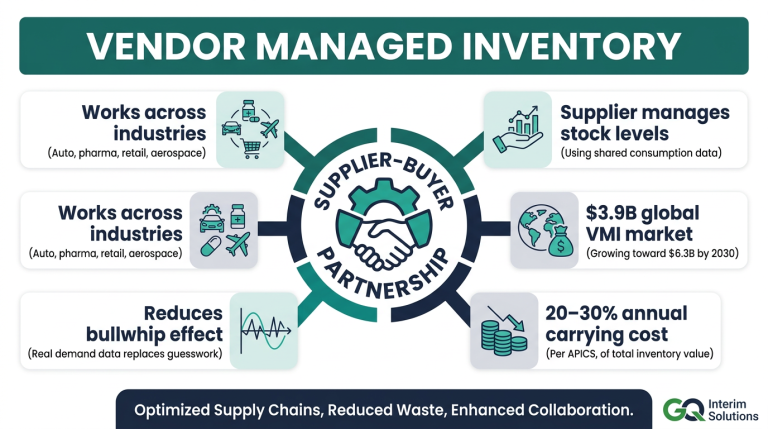
For strategic and bottleneck suppliers, add a supplier scorecard and a development plan. If quality is the weak point, our guide to supplier quality management shows how to set up audits and corrective actions. For high-volume parts with stable demand, vendor managed inventory can move stock planning to the supplier. Compare suppliers in the same segment on total cost of ownership, not unit price.

What are the most common supplier segmentation mistakes?
- Too many segments. A model with ten groups is hard to maintain and nobody remembers the rules for each.
- Spend only. Ignoring supply risk puts single-source parts in the non-critical group.
- No updates. A supplier that was non-critical several years ago may now deliver a key part for a new product.
- No change in practice. Assigning suppliers to segments without changing contracts, reviews and stock rules brings no benefit.
- Procurement alone. Without input from quality, engineering and operations, the scores miss the real production risk.
Start with your top 50 suppliers by spend and every supplier of a single-source part. Score them on spend, supply risk and impact on production, and agree on the rules for the strategic and bottleneck groups first. That covers most of the risk with a small part of the effort.
How does supplier segmentation make the supply chain more resilient?
Chip shortages, closed borders and supplier insolvencies in recent years have shown that price and contract value are not enough to manage a supply base. Companies with a clear segmentation react faster when the market changes. They already know which suppliers need attention first, where safety stock is needed and for which parts a second source is in approval.
The same overview supports inventory planning, supplier development, quality management and long-term sourcing decisions. Instead of reacting after the line stops, the team can act in advance, based on supplier importance and risk. When a disruption or an acquisition changes the picture, re-score the affected suppliers right away instead of waiting for the annual review.
When does an interim procurement manager help with supplier segmentation?
Building a segmentation needs someone who has done it before, and a plant’s purchasing team is often fully busy with daily orders. An interim manager for procurement or supply chain brings that experience for a fixed assignment. Typical situations:
- A supplier crisis shows that nobody knows which suppliers are critical.
- After an acquisition two supplier bases have to be merged and segmented with one method.
- The head of purchasing has left and the supplier strategy needs an owner while you search for a successor.
- A new plant or product launch needs a supply base with clear rules from the start.
Choose the person on comparable experience: similar categories, a similar industry and results they can put numbers on. Our guide on how to choose an interim manager lists the questions to ask.
How GQ Interim helps with supplier segmentation
Since 2011 we have completed more than 1,550 projects in manufacturing and industrial companies across Central and Eastern Europe, for clients such as Stellantis, Porsche, Siemens, Valeo and Magna. Our database holds 7,500+ verified experts, including procurement directors, category managers, supplier quality engineers and supply chain managers. We shortlist people who have done the same job before and check their references from earlier assignments. See our interim solutions for the ways we work. We are certified to ISO 9001 and TISAX.
Conclusion
Supplier segmentation moves procurement beyond transactional purchasing. Score your suppliers on spend, supply risk and impact on production, place them in a few clear segments and give each segment its own rules for contracts, reviews, stock and backup sources. Review the segments regularly, and your team spends its time where it protects production and cost.
Get a procurement expert this week
Tell us which suppliers or categories need attention. We come back with profiles of experts who have solved the same problem.
Frequently asked questions
What is supplier segmentation?
Supplier segmentation is the practice of grouping suppliers by criteria such as spend, supply risk and impact on production, and managing each group differently. Strategic suppliers get partnerships and regular reviews, simple suppliers get standard contracts and minimal effort.
What is a supplier segmentation matrix?
A supplier segmentation matrix places suppliers on two axes, most often profit impact and supply risk, as in the Kraljic matrix. The four resulting segments are strategic, competitive, bottleneck and non-critical items, each with its own buying strategy.
What are the four quadrants of the Kraljic matrix?
Strategic items with high impact and high risk, competitive items with high impact and low risk, bottleneck items with low impact and high risk, and non-critical items with low impact and low risk. Partner on strategic items, use competition for competitive items, secure bottleneck items and simplify non-critical ones.
What criteria are used for supplier segmentation?
Annual spend, supply risk, impact on production, product complexity, supplier performance, strategic value and, increasingly, sustainability and compliance data. Most companies use three to five of them and score every supplier the same way.
What is the difference between supplier segmentation and supplier tiering?
Supplier tiering usually ranks suppliers into levels such as tier 1, 2 and 3 by importance, or describes their position in the supply chain. Supplier segmentation is broader: it groups suppliers by several criteria and defines a different management strategy for each group.
Is spend-based segmentation enough?
No. Spend shows where the money goes, but not where the risk is. A low-cost part with a single approved supplier can stop production. Combine spend with supply risk and impact on production.
How often should you update supplier segmentation?
At least once a year, and right after events that change the risk, such as a supplier crisis, an acquisition, a new product launch or a change in the supply market.
Do you need software for supplier segmentation?
Not to start. A spreadsheet with spend data from the ERP and agreed scores is enough for most plants. Supplier relationship management tools help when you have many sites and want scorecards and risk data in one place.
Who should own supplier segmentation?
Procurement owns the process, but quality, engineering, operations and finance should help score the suppliers. If nobody has the capacity, an interim procurement manager can set up the segmentation and hand it over. GQ Interim gets an experienced expert on site within 72 hours.