


- Why businesses decide to expand to new markets
- Choosing the right market entry strategy
- How interim experts support international expansion
- Common mistakes to avoid
Growing beyond your home market is an exciting milestone, but it changes far more than your sales territory. New customers bring different expectations, local regulations reshape familiar processes, and teams suddenly find themselves managing suppliers, partners, and operations they have never worked with before.
Many companies prepare extensively for winning business in a new country. Fewer prepare for everything that comes after the contract is signed. Can production handle additional demand? Is the supply chain ready? Who will manage local operations? Does your leadership team have enough capacity to support expansion while keeping the existing business running?
These questions often determine whether international expansion becomes a long-term success or an expensive distraction.
The good news is that expanding into new markets does not require a complete organisational overhaul. With the right preparation, realistic planning, and experienced people in key roles, companies can grow internationally without losing control of their day-to-day operations.
This guide explains how to expand to new markets, what challenges businesses commonly face, and how to build an expansion strategy that supports sustainable growth.
Why businesses decide to expand to new markets
There is rarely a single reason behind international expansion. Sometimes domestic demand has reached its limit. In other cases, existing customers ask suppliers to support projects in another country. Manufacturers may open facilities closer to OEMs, while service companies look for regions with stronger demand or less competition.
Expansion can help businesses:
- diversify revenue across multiple markets
- reduce dependence on one country or industry
- strengthen relationships with international customers
- gain access to specialised talent or suppliers
- increase production or service capacity
- create new opportunities for long-term growth.
The objective matters because it shapes every decision that follows. A company opening a sales office will face different challenges than one relocating production or launching a manufacturing site abroad. Understanding the purpose behind the expansion makes it easier to allocate resources, prioritise investments, and measure success.
Is your business ready for expansion?
One of the biggest misconceptions about international growth is that financial investment is the main requirement. Capital certainly matters, but operational readiness often has a much greater impact on the outcome.
Before entering a new market, take an honest look at how your business operates today.
- Can your leadership team support another location without slowing down existing projects?
- Are your processes documented well enough to be replicated elsewhere?
- Do your reporting systems provide accurate information across multiple sites?
- Can procurement, logistics, finance, and customer support absorb additional workload?
If the answer to several of these questions is no, expansion is still possible. It simply means certain capabilities need strengthening before the business scales further.
Companies that recognise these gaps early usually solve them faster and at a lower cost than those reacting after problems appear.
Common challenges when entering a new market
Building a local operation from scratch
Hiring people is only one part of the process. New employees need clear responsibilities, practical procedures, reporting structures, and leadership. Without those foundations, even experienced professionals struggle to work efficiently.
Managing operations across multiple locations
What worked well in one office or production plant does not automatically transfer to another. Communication becomes more complex, decision-making slows down, and small misunderstandings can quickly affect delivery performance or customer satisfaction.
Standardised processes become increasingly important as organisations grow. Teams should know who owns each decision, how information flows, and what happens when unexpected issues arise.
Understanding local regulations
Employment law, taxation, certification requirements, environmental regulations, and contractual obligations vary from country to country. Missing a compliance requirement can delay projects, increase costs, or create legal complications that could have been avoided with better preparation.
Strengthening the supply chain
Expanding into a new market often means working with unfamiliar suppliers, transport providers, and logistics partners.
Lead times may differ from those at home. Local sourcing strategies need validation. Inventory policies frequently require adjustment, especially when production serves multiple countries or customers with different delivery expectations.
Businesses that involve procurement and supply chain teams early tend to avoid many of the disruptions that appear after launch.
Choosing the right market entry strategy
There is no universal approach to international expansion. The right strategy depends on your objectives, available resources, level of investment, and appetite for risk.
Some companies begin with distributors or local partners before establishing their own presence. Others open a sales office, acquire an existing business, or build manufacturing capacity close to major customers.
Each option comes with different advantages.
Working with local partners usually requires less upfront investment and allows businesses to test market demand before committing additional resources.
Opening your own operation offers greater control over customer relationships, quality standards, and company culture, although it also increases operational complexity.
Manufacturers frequently combine several approaches. They may start with local sales and technical support before expanding into warehousing, engineering, or production once customer demand becomes predictable.
Rather than asking which strategy is best, ask which one matches your current stage of growth.
Why people matter more than the plan
Expansion strategies often focus on markets, competitors, and financial projections. The execution depends on people.
Experienced leaders make decisions faster because they recognize familiar situations. They know how to establish reporting structures, build local teams, negotiate with suppliers, and keep projects moving when unexpected challenges arise.
Without that experience, organisations often rely on managers who are already responsible for their existing operations. Those additional responsibilities can stretch leadership capacity and slow progress in both locations.
This is one reason many businesses strengthen key functions before or during expansion instead of waiting until problems appear.
Download our e-book
Download our free e-book to discover how GQ Interim can transform your business with expert leadership solutions!
How interim experts support international expansion
International expansion creates temporary challenges that do not always justify permanent hiring.
A business may need an experienced operations manager to launch a new production site, a supply chain manager to establish local logistics, or a finance director to prepare reporting structures across multiple countries. Once the project is complete, those responsibilities may return to the permanent leadership team.
Interim professionals provide access to experienced specialists exactly when they are needed.
Because they have often managed similar projects before, they can quickly identify priorities, establish practical processes, support internal teams, and keep expansion moving without lengthy onboarding.
For businesses entering unfamiliar markets, this approach offers flexibility while reducing the pressure on existing managers.
Common mistakes to avoid
Successful companies rarely avoid every challenge. They avoid repeating predictable mistakes.
The most common include:
- expanding before internal processes are mature
- underestimating operational complexity after the first customer wins
- relying on a small number of overloaded managers
- delaying local hiring until growth has already accelerated
- treating expansion as a sales project instead of a business-wide initiative
- assuming practices from one country will automatically work elsewhere.
Recognizing these risks early gives businesses more options and significantly reduces the likelihood of costly delays.
Interim statistics
Word from our CEO
Expanding into a new market isn’t only about finding new customers. It’s about building the right operational foundation. The companies that prepare well don’t just grow faster, they grow with confidence.

CEO GQ Interim
Conclusion
Expanding into a new market is more than a commercial opportunity. It is an operational project that touches almost every part of the business.
Companies that prepare carefully, invest in the right capabilities, and strengthen leadership where needed are far more likely to achieve sustainable growth than those relying on ambitious targets alone.
Whether you are opening a new office, supporting international customers, or launching production abroad, success depends on balancing growth with operational stability. The stronger that balance is, the easier it becomes to expand confidently without losing focus on the business you have already built.
Frequently asked questions
Looking for answers about how expanding to new markets work? Our FAQ section covers common questions, helping you quickly understand how we deliver tailored solutions for your business needs.
The right time depends on more than revenue growth. Your business should have stable operations, documented processes, sufficient leadership capacity, and the financial resources to support expansion. Entering a new market before those foundations are in place often creates challenges for both the new and existing business.
For many companies, the biggest challenge is execution rather than strategy. Hiring local talent, adapting operations, managing suppliers, complying with local regulations, and maintaining service quality all require careful coordination. A strong plan only delivers results if the business has the capability to execute it.
There is no single answer. Some businesses start with local partners or distributors before building their own team, while others recruit key employees from the beginning. The right approach depends on your business model, investment level, and long-term objectives.
Interim professionals provide experienced leadership for specific stages of an expansion project. They can help establish local operations, strengthen supply chain processes, manage production launches, build new teams, or lead strategic initiatives until the business is ready to transition responsibilities to permanent employees.
Interested in Interim Expert?
Discover how interim management can dramatically increase the efficiency of your business. Get in touch with our team to learn how working with GQ Interim will improve your company.
- Get started within few days
- Database of 10 000+ consultants
- Solving crucial problems of your business
- Custom solutions for your business needs
- Proven results with measurable impact
Related articles
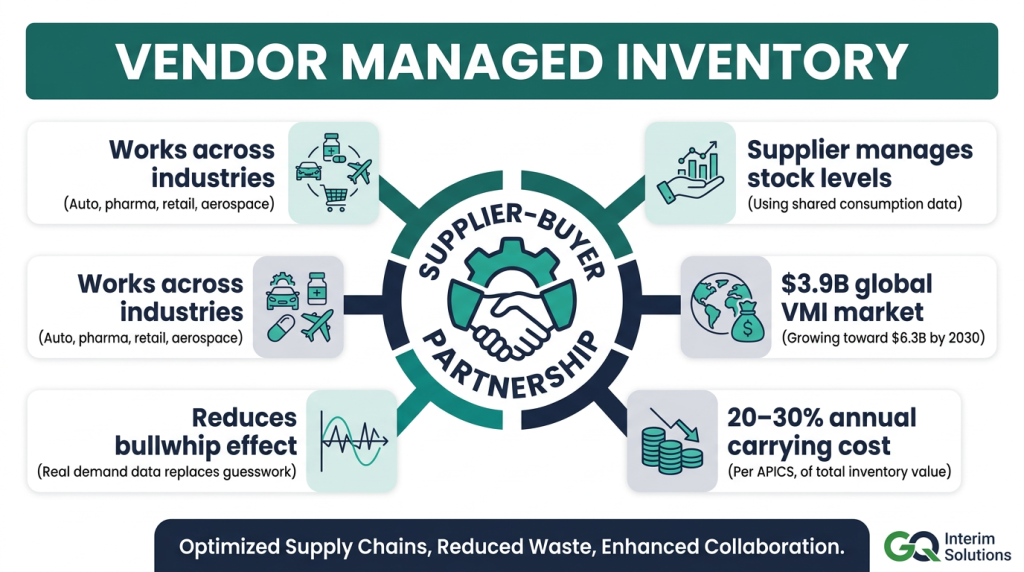
- Wondering if Vendor Management Inventory is right for your plant or network? This guide unpacks how VMI works, where it delivers savings and stability, the pitfalls to avoid, and the KPIs and tech you need to stay in control.

- Managing every supplier the same way rarely delivers the best results. Supplier segmentation helps businesses prioritize supplier relationships, reduce risk, and focus procurement efforts where they create the greatest value.

- Hiring a senior sales leader is one of the most important decisions a growing business can make. Learn how sales executive search works, when it's the right choice, and why it consistently delivers stronger long-term hiring outcomes than traditional recruitment.

- Great products don't happen by accident. Behind every successful product is strong leadership that aligns business strategy, customer needs, and cross-functional teams. Discover what product leadership involves, why it matters, and how it helps businesses make better product decisions.
