

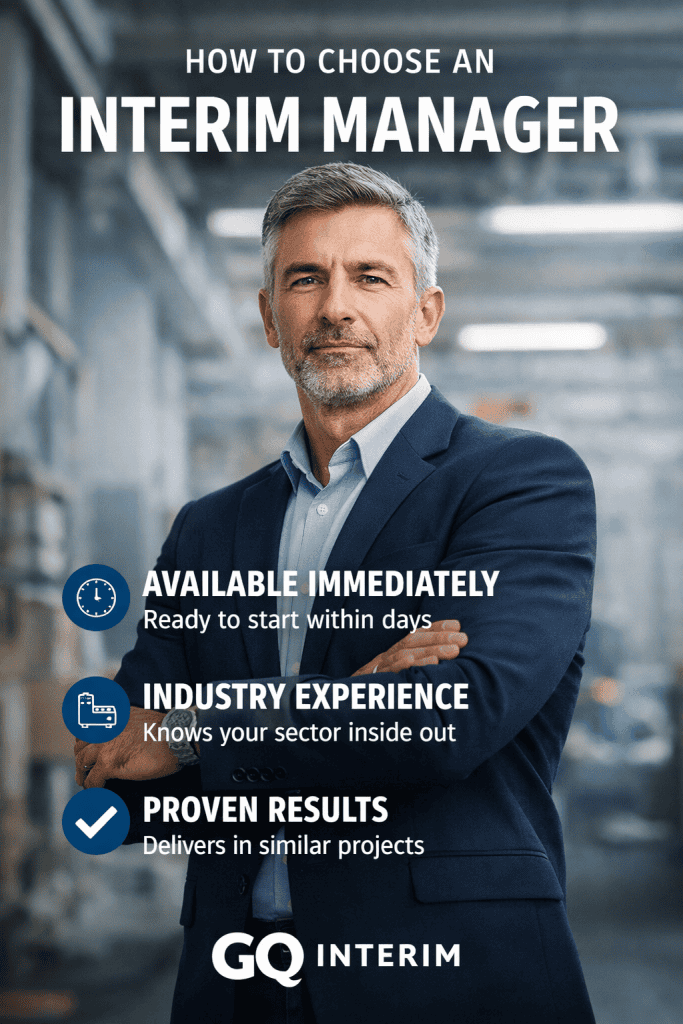
- Availability
- Language Skills
- Industry Experience
- Consistency and Reliability
How to Choose an Interim Manager?
Bringing in an interim manager usually happens under pressure. A project is slipping, a key role is suddenly empty, or a specific expertise is missing in the team. In these situations, the wrong choice slows everything down even more. The right one stabilizes the situation and starts moving things forward almost immediately.
Choosing an interim manager is not about scanning CVs. It is about understanding what your situation requires and matching it with someone who has already handled a similar challenge in practice.
At GQ Interim, the selection process follows a few clear principles. Each of them exists for a reason, shaped by real project demands and timelines.
Availability Shapes the Outcome from Day One
When a company decides to bring in an interim manager, time is already a factor. Waiting weeks for someone to become available rarely aligns with the urgency behind the decision.
An interim professional needs to step in quickly and start operating within days, not weeks. That means understanding the environment fast, connecting with the team, and taking ownership without a long adjustment period.
Delays at this stage often lead to missed deadlines, internal frustration, and additional pressure on existing teams. Fast availability is not just a convenience, it directly affects how quickly the situation improves.
Language Skills Are Not Optional in Execution Roles
In many projects, communication sits at the center of execution. Whether it is coordinating with production teams, aligning with management, or working across international stakeholders, language gaps slow everything down.
An interim manager with strong language skills can:
- Integrate into the team without friction
- Avoid misunderstandings in critical decisions
- Keep communication clear across departments
Without that, even a highly skilled expert can struggle to deliver impact. The work may be technically correct, but progress becomes slower and less predictable.
Industry Experience Shortens the Learning Curve
Every industry has its own specifics. Processes, expectations, and common issues vary significantly between sectors such as automotive, manufacturing, or logistics.
An interim manager who already understands your environment does not need time to “figure things out.” They recognize patterns early, know where problems usually originate, and can focus directly on solving them.
This reduces the risk of trial-and-error decisions and allows the project to move forward with more confidence from the start. If you are evaluating options, it helps to look at projects that closely match your situation, not just general experience.
Download our e-book
Download our free e-book to discover how GQ Interim can transform your business with expert leadership solutions!
Benefits of an Interim Manager
Bringing in an interim manager is often a response to a very specific business need. Whether the issue is operational, structural, or project-related, the value comes from fast, targeted impact without long-term commitment.
Immediate Impact
An experienced interim manager does not need months to understand the environment. They step in, assess the situation quickly, and begin executing within days. This shortens recovery time in critical situations and helps teams regain direction faster.
Specialized Expertise
Interim professionals are typically brought in for a reason, a gap in knowledge or experience that internal teams do not cover. Instead of training or hiring long-term, companies gain direct access to someone who has already handled similar challenges.
Objective View
Internal teams can be influenced by existing processes, habits, or internal dynamics. An interim manager looks at the situation from the outside, which allows for clearer decision-making and more direct problem-solving.
Flexible Engagement
Interim solutions give companies the ability to address specific needs without expanding permanent headcount. Once the objective is achieved, the engagement ends, keeping the organization lean and focused.

Relevant Experience Matters More Than Impressive Profiles
A strong profile alone does not guarantee the right fit. What matters is whether the interim manager has handled a situation similar to yours, with comparable scope and complexity.
For example, managing a team through a delayed production launch requires a different approach than optimizing an already stable process. The context defines the skills needed.
That is why the selection should always be based on:
- Real project experience
- Comparable challenges
- Proven outcomes in similar environments
This approach removes guesswork and replaces it with evidence.

Certified Professionals Bring Consistency and Reliability
Interim management is not just about expertise. It is also about professionalism, accountability, and the ability to deliver under pressure.
Working with certified professionals with a strong track record adds a layer of reliability. These individuals are used to stepping into demanding situations, aligning with stakeholders quickly, and delivering results without unnecessary escalation. This consistency becomes especially important in high-stakes projects where there is little room for error.
Interim statistics
The Right Interim Is Not About Availability, It’s About Fit
“In critical situations, companies often focus on speed, but speed without the right expertise creates more problems than it solves. The real value of interim management comes from matching the exact experience to the challenge at hand. When that alignment is right, progress is not only faster, it is more stable and predictable.”

CEO GQ Interim
Conclusion
Selecting an interim manager is a focused decision. It requires clarity about your situation and a structured way to match that need with the right expertise.
At GQ Interim, the goal is simple. No guesswork, no unnecessary delays, and no mismatched profiles. Just the right expert, ready to step in and move your project forward.
If you want to explore how this works in practice, you can look at our interim management solutions or speak directly with our team about your current situation.
Frequently asked questions
Looking for answers about how Interim Managers work? Our FAQ section covers common questions, helping you quickly understand how we deliver tailored solutions for your business needs.
An interim manager is an experienced professional hired on a temporary basis to handle a specific business need, such as covering a leadership gap, managing a project, or solving an operational issue.
Companies typically hire an interim manager when they need immediate expertise. Common situations include sudden leadership gaps, delayed projects, production issues, or when internal teams lack specific experience.
To choose the right interim manager, focus on availability, relevant industry experience, language skills, and proven results in similar projects. The decision should be based on practical experience, not just profiles.
In most cases, an interim manager can start within a few days. Fast availability is one of the main advantages, especially in situations where delays would impact operations or project timelines.
Interested in Interim Expert?
Discover how interim management can dramatically increase the efficiency of your business. Get in touch with our team to learn how working with GQ Interim will improve your company.
- Get started within few days
- Database of 10 000+ consultants
- Solving crucial problems of your business
- Custom solutions for your business needs
- Proven results with measurable impact
Related articles

- Choosing the right interim manager is not about CVs, but about matching real experience to real business challenges. Here’s how to make the right call when timing and results matter. See what criteria actually influence project outcomes and team performance.

- A balanced scorecard example demonstrates how organizations can measure more than just financial performance. Developed by Robert Kaplan and David Norton, the balanced scorecard tracks goals across finance, customers, internal processes, and learning & growth. By aligning these perspectives, it ensures that daily operations support long-term strategy and sustainable growth.

- The Theory of Constraints (TOC) is a structured approach to improving organizational performance by focusing on the single most limiting factor—the constraint. Whether it’s a production bottleneck, market demand, or a sales conversion gap, TOC answers three core questions—what to change, to what to change, and how to cause the change—and drives continuous improvement through five disciplined steps: identify, exploit, subordinate, elevate, and repeat.

- Software quality assurance ensures that software consistently meets stakeholder needs by preventing defects and validating that products align with defined quality attributes (e.g., reliability, security, performance). Blending defect management practices with standards-based quality models like ISO/IEC 25010 helps teams plan, measure, and continuously improve quality throughout the lifecycle.
