


- Why is it important?
- How to use it?
- Implementation
- Practical balanced scorecard wxamples
What is balanced scoreboard?
Balanced scorecard (BSC) was created by Robert Kaplan and David Norton and it is based on the philosophy which says “if you cannot measure it, you cannot manage it then”. BSC offers a way for an organization to achieve a wider perspective on its strategic decisions by considering the influence and impact on finances, customers, internal processes and employee learning.
It is designed to measure the success degree in implementation of business strategy. The analysis takes into account financial and nonfinancial measures, internal improvements, past outcomes and ongoing requirements as indications of future performance.
Why is it important?
BSC helps to transform the organizational strategy into action and align employees to common goals. Also it helps to eliminate the conflict between goals caused by functional targets.
How to use it?
Identify the relevant critical success factors in the BSC perspectives – define the crucial capabilities and purposes of the department and explore inter-relationships.
Examples of factors:
- Finance / cashflow, return on investment, return on capital employed, financial results
- Internal business processes / number of activities per function, duplicate activites accross functions, process alignment (is the right process in the right department?) , process bottlenecks , process automation
- Learning and personal growth / Is there the correct level of expertise for the job?, employee turnover, job satisfaction, training or learning opportunities
- Customer / delivery performance to customer, quality performance for customer, customer satisfaction rate, customer percentage of market, customer retention rate
- Technology / evaluation of technology required to carry out the activity efficiently
Implementation
Implementation of BSC should be resulted in:
- Improved processes
- Motivated and educated employees
- Enhanced information systems
- Monitored progress
- Greater customer satisfaction
- Increased financial usage
Remember: The metrics and aims set up also must be SMART, as we mentioned above you cannot improve on what you cannot measure.
Download our e-book
Download our free e-book to discover how GQ Interim can transform your business with expert leadership solutions!
Practical balanced scorecard examples
Below are two balanced scorecard example setups—each shows objectives, KPIs, targets, and initiatives across the four classic perspectives so you can see how strategy becomes measurable action.
1. Manufacturing company
In a manufacturing environment, the balanced scorecard connects shop floor performance with financial outcomes. Delays in production, quality issues, or inefficient processes quickly translate into higher costs and missed delivery commitments.
This type of structure helps manufacturing companies identify where operational issues originate and how they impact both customer satisfaction and financial performance.
A typical setup could look like this:
Financial:
- Objective: Improve profitability per production line
- KPI: Cost per unit, gross margin
- Target: Reduce cost per unit by 8% within 6 months
- Initiative: Optimize material usage and reduce scrap rates
Customer:
- Objective: Improve delivery reliability
- KPI: On-time delivery (OTIF)
- Target: Reach 96% OTIF
- Initiative: Introduce production planning adjustments and buffer stock for critical components
Internal processes:
- Objective: Increase production efficiency
- KPI: Overall equipment effectiveness (OEE), cycle time
- Target: Improve OEE from 70% to 80%
- Initiative: Implement preventive maintenance and reduce unplanned downtime
Learning & growth:
- Objective: Strengthen operator capabilities
- KPI: Training hours per employee, error rate
- Target: Reduce operator-related errors by 20%
- Initiative: Introduce targeted training for key production roles
2. B2B SaaS provider
In a B2B SaaS company, performance is driven by customer retention, product usage, and predictable revenue growth. The balanced scorecard helps connect product, marketing, and customer success efforts into one clear framework.
For SaaS companies, this approach makes it easier to see how product decisions, customer experience, and revenue growth are connected, rather than managed in isolation.
A typical setup could look like this:
Financial:
- Objective: Increase recurring revenue
- KPI: Monthly recurring revenue (MRR), net revenue retention (NRR)
- Target: Grow MRR by 15% over 6 months
- Initiative: Expand upsell opportunities within existing accounts
Customer:
- Objective: Improve customer retention
- KPI: Churn rate, customer satisfaction (CSAT)
- Target: Reduce churn from 8% to 5%
- Initiative: Strengthen onboarding and customer success engagement
Internal processes:
- Objective: Improve product adoption
- KPI: Feature usage rate, time-to-value
- Target: Increase adoption of key features by 25%
- Initiative: Redesign onboarding flow and in-app guidance
Learning & growth:
- Objective: Strengthen cross-team alignment
- KPI: Campaign-to-revenue conversion, team productivity
- Target: Improve marketing-to-sales conversion rate by 10%
- Initiative: Align product, marketing, and sales teams around shared KPIs
How to apply this
Use each balanced scorecard example as a template, then tailor it to your strategy and context:
- Select priorities per perspective. Confirm 1–2 high‑impact objectives for Financial, Customer, Internal Process, and Learning & Growth.
- Define clear KPIs. Choose metrics you can reliably capture now (avoid vanity metrics).
- Set SMART targets. Specify baseline, target, and deadline so progress is unambiguous.
- Assign ownership. Name one accountable owner per KPI and list supporting contributors.
- Map initiatives to gaps. Launch only those projects that directly move the KPI toward the target.
- Establish cadence. Review monthly, pivot initiatives quarterly, and refresh objectives annually.
- Instrument and visualize. Track in a dashboard (e.g., OTIF, FPY, NRR, lead time) and make results visible to stakeholders.
Applied this way, a balanced scorecard example becomes a living operating system—aligning teams, focusing investment, and turning strategy into measurable outcomes.
Conclusion
A strong balanced scorecard example does more than report numbers—it turns strategy into disciplined execution. By aligning Financial, Customer, Internal process, and Learning & growth objectives with clear KPIs, SMART targets, owners, and focused initiatives, organizations gain a single operating view of performance and priorities.
Use the two tables as starting templates, then follow How to apply this to tailor them to your context: pick high‑impact objectives, choose reliable metrics, set explicit targets, assign ownership, map initiatives to gaps, review on a set cadence, and visualize results. Applied consistently, the balanced scorecard becomes a living system that sharpens focus, speeds decision‑making, and drives measurable, cross‑functional improvement.
Interested in Interim Expert?
Discover how interim management can dramatically increase the efficiency of your business. Get in touch with our team to learn how working with GQ Interim will improve your company.
- Get started within few days
- Database of 10 000+ consultants
- Solving crucial problems of your business
- Custom solutions for your business needs
- Proven results with measurable impact
Related articles
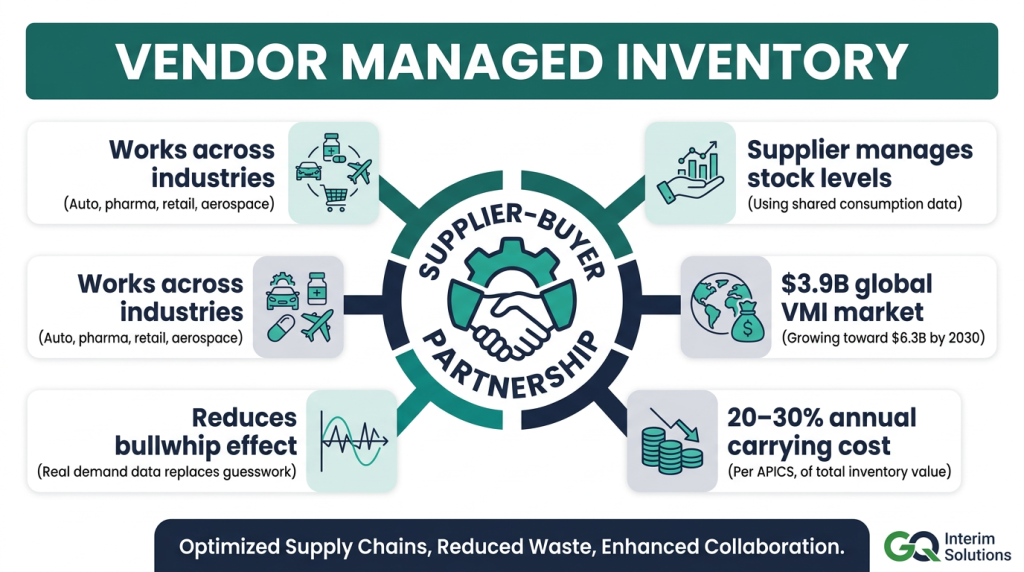
- Wondering if Vendor Management Inventory is right for your plant or network? This guide unpacks how VMI works, where it delivers savings and stability, the pitfalls to avoid, and the KPIs and tech you need to stay in control.

- Managing every supplier the same way rarely delivers the best results. Supplier segmentation helps businesses prioritize supplier relationships, reduce risk, and focus procurement efforts where they create the greatest value.

- Hiring a senior sales leader is one of the most important decisions a growing business can make. Learn how sales executive search works, when it's the right choice, and why it consistently delivers stronger long-term hiring outcomes than traditional recruitment.

- Great products don't happen by accident. Behind every successful product is strong leadership that aligns business strategy, customer needs, and cross-functional teams. Discover what product leadership involves, why it matters, and how it helps businesses make better product decisions.
