

Introduction
Supply chains miss orders, lines stop, and working capital sits in the warehouse. Vendor managed inventory (VMI) often appears as the promised fix.
The real pain comes from guessing order quantities, chasing suppliers, and reacting too late to demand swings. That pattern drains margins and energy for operations teams at every level.
Vendor managed inventory is a model where the supplier uses shared data to keep stock at the right level in the customer facility. Recent research from The Insight Partners values the global VMI market at about 3.9 billion dollars in 2023, with a path toward 6.3 billion by 2030. This guide walks through what VMI means, how it works, its benefits and risks, how it compares to other models, and how GQ Interim helps leaders put it in place without losing time.
Keep reading to see how vendor managed inventory can streamline operations while you stay in control of service, cost, and risk.
Key takeaways
Key lessons from vendor managed inventory help leaders quickly judge if the approach fits their plant or network. The bullets below give a fast preview before the deeper sections. Each point links directly to everyday decisions in manufacturing, automotive, and logistics.
Vendor managed inventory means the supplier monitors stock at the customer site and decides replenishment based on real usage data. The buyer shares sales or consumption information and agrees target ranges for each item. This shared view replaces guesswork orders and gives a more stable planning base for both sides.
The model runs through clear stages that cover agreements, data connections, daily monitoring, and regular reviews. A solid VMI setup depends on ERP or warehouse data flowing accurately to the supplier. When that happens, planning tools and AI driven analytics from vendors such as SAP or Oracle can support smarter restocking choices.
Buyers gain lower inventory carrying cost, fewer stockouts, and less time tied up in ordering tasks. Suppliers gain better demand insight, smoother production, and protection from the bullwhip effect. Research from Deloitte shows companies with strong supply chains are far more likely to report above average revenue growth.
VMI comes with real challenges that range from data quality and security to culture change and fear of losing control. Clear contracts, shared KPIs, and structured communication routines keep both sides aligned. Change management support, often from outside experts such as GQ Interim, helps teams adopt new ways of working.
VMI sits beside models like just in time, consignment, and drop shipping rather than replacing them entirely. Many firms use a mix, applying vendor managed inventory to high volume or high risk items while leaving slow movers on traditional ordering. The key is to pick the right tool for each item family rather than forcing one pattern everywhere.
What is vendor managed inventory?
Vendor managed inventory is a supply chain model where the supplier, not the buyer, takes daily responsibility for inventory levels at the customer site. The supplier receives regular data about stock, usage, and sometimes forecasts, then ships to keep each item inside agreed minimum and maximum levels. This answers the common search for a clear vendor managed inventory definition or a simple way to define vendor managed inventory.
From the buyer side, people often talk about supplier managed inventory or vendor managed stock. When ownership remains with the supplier until use, some call it vendor owned inventory. That is why terms such as vendor owned inventory definition or supplier managed inventory definition appear so often, although the operational idea stays the same: the supplier steers replenishment while the buyer shares accurate data.
VMI in logistics sits at the point where transport, warehousing, and planning meet. Retailers like Walmart and manufacturers such as Procter & Gamble used early forms of VMI to cut stockouts while reducing total stock. According to APICS, typical inventory carrying cost ranges between 20 and 30 percent of inventory value each year, so any reduction in extra stock can quickly free cash for other work.
For searchers asking what is vendor management inventory or looking for a vendor management inventory definition, the short answer is simple. It is a data driven agreement where the supplier monitors and manages inventory levels for the customer, within limits the two parties set together.
How does a vendor managed inventory model work?
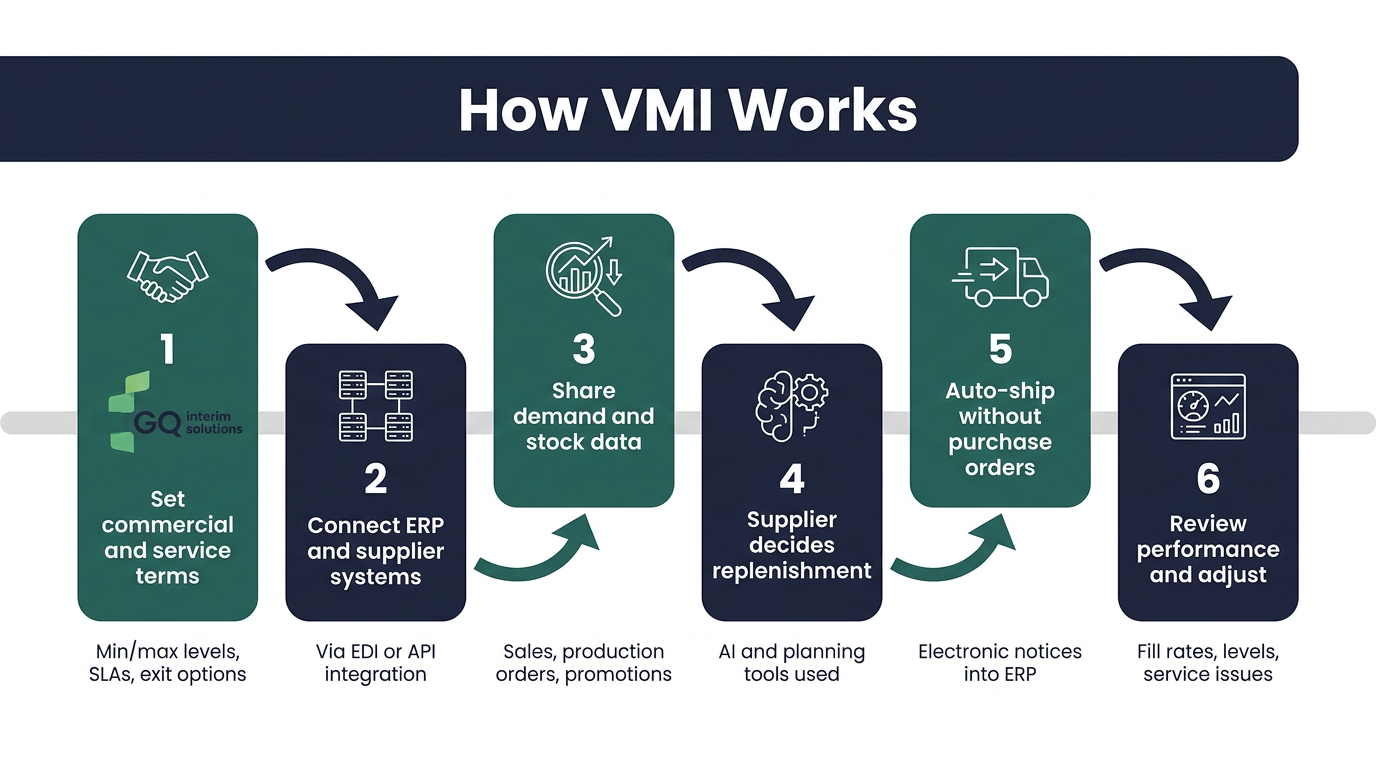
A vendor managed inventory model uses a clear sequence of steps that turn shared data into daily replenishment decisions. Both sides agree the rules up front and then rely on connected systems instead of email threads and urgent phone calls. Here is how that usually looks in practice.
Set commercial and service terms. The buyer and supplier agree which items and locations enter the program and what minimum and maximum levels make sense for each one. They also fix service targets such as in stock rate and lead time and document return rules and exit options. Legal and finance teams on both sides review these points so there are no surprises later.
Connect systems for data flow. The buyer links its ERP or warehouse system, such as SAP S/4HANA or Oracle NetSuite, to the supplier system using EDI or API links. This link passes item numbers, stock balances, and movements in a standard format. Real time or at least daily updates remove the lag that often harms planning accuracy.
Share ongoing data about demand and stock. Once the connection works, the buyer sends regular information about sales, production orders, and planned promotions. The supplier uses this feed as the single source of truth rather than guessing from past purchase orders. Research from Gartner notes that real time data can improve forecast accuracy by double digit percentages in many supply networks, a trend supported by findings on A STUDY OF VENDOR management systems across modern supply chains.
Let the supplier decide replenishment. The supplier checks current levels against the target range and plans shipments to keep each item inside that band. Advanced users plug this data into demand planning tools and AI models hosted on platforms such as Microsoft Azure or Google Cloud. The aim is to adjust quickly as patterns shift rather than waiting for a manual reorder signal.
Ship automatically without a manual purchase order. When stock reaches the trigger point, the supplier creates the delivery and ships based on the agreement. The buyer still receives shipping notices and invoices, often as electronic documents directly into the ERP system. This removes many small purchase orders and approvals that used to consume planner time.
Review performance and adjust rules. Buyer and supplier teams meet on a regular cadence to check fill rates, inventory levels, and service issues. They adjust minimums, maximums, and forecast settings based on what the data shows. Over time, this loop makes the vendor managed inventory model more reliable and easier to extend across parts of the product range.
What technology does VMI require?
Vendor managed inventory depends on steady and accurate data links more than any single software brand. The goal is a clear picture of stock and demand on both sides, supported by tools that can react quickly. Technology teams and supply chain teams often need to work together to reach that point.
A VMI setup needs real time or near real time inventory visibility across plants, warehouses, and sometimes retail sites. That view usually comes from an ERP or warehouse system from vendors such as SAP, Oracle, or Microsoft Dynamics that records every movement. When the supplier can see that view, it can plan shipments before problems appear.
Stable integration between buyer systems and supplier systems sits at the heart of VMI in logistics. Electronic data interchange and modern API links keep item, order, and delivery data aligned without manual uploads. Cloud platforms from providers such as AWS or Google Cloud help smaller firms connect without heavy up front hardware spend.
Shared forecasting and analytics tools turn raw data into insight. Machine learning models can spot seasonality, promotion impact, or location specific patterns that human planners might miss. According to McKinsey, advanced analytics in supply chains can raise service levels while cutting inventory and logistics cost at the same time.
“In God we trust; all others must bring data.” — W. Edwards Deming
Strong cybersecurity, access control, and data governance complete the picture so that sensitive commercial data stays protected while still flowing where it needs to go.
What are the benefits of vendor managed inventory?
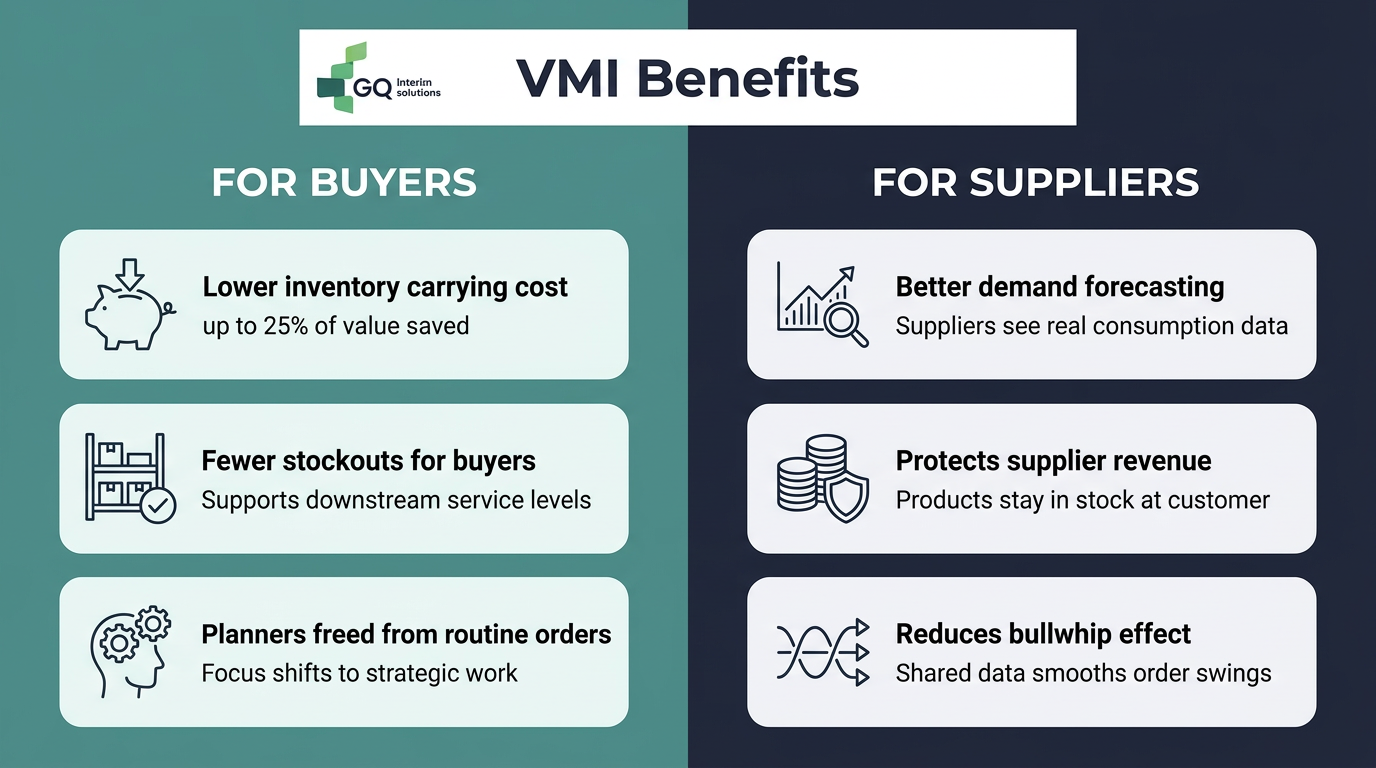
Vendor managed inventory creates value for both buyers and suppliers when the program runs correctly. Buyers see lower stock levels and smoother operations, while suppliers see steadier demand and fewer surprises. Together, both sides also reduce the bullwhip effect that sends exaggerated demand swings up the chain.
For customers and buyers, VMI can lighten the weight of inventory on the balance sheet. Better alignment between stock and real demand lowers safety stock and cuts warehouse space and insurance. According to CSCMP, carrying cost often reaches a quarter of inventory value each year, so even modest reductions matter for finance leaders. Buyers also see fewer stockouts, which supports better service levels for downstream customers.
Another buyer benefit is time. When planners, buyers, and supervisors no longer spend hours placing routine orders, they can focus on supplier development, process improvement, or production planning. Automotive plants run by firms like Toyota or BMW often use vendor managed inventory on high runner parts to support smooth takt time on the line. The model also improves cash flow because frequent smaller deliveries shorten the gap between paying for stock and selling finished goods.
VMI also helps with inventory accuracy and shrinkage. In many vendor owned inventory setups, the supplier keeps legal ownership of stock until the buyer uses it. That gives the supplier a direct financial interest in careful handling, correct counts, and clean storage conditions. Over time, that focus reduces write offs from damage, expiry, or theft.
For suppliers and vendors, the benefits start with better demand forecasting. Access to customer point of sale or consumption data gives a far clearer picture than simple purchase order history. That view helps component makers for companies like Ford or General Motors match production to real demand and reduce the need for overtime or last minute changeovers.
Suppliers also protect revenue when their products stay in stock at the customer site. If a buyer never runs out, it has less reason to test alternate suppliers. VMI often deepens relationships, and suppliers can use that trust to co plan promotions or new product introductions. Research from PwC shows that supply chains with tight collaboration between partners tend to deliver higher service and lower end to end cost.
How does VMI compare to other inventory management models?
Vendor managed inventory sits beside other common models, each with its own strengths. Leaders often ask how it compares with just in time, consignment, and other setups. The table below gives a short view.
| Approach | Key feature | Difference from vendor managed inventory |
|---|---|---|
| Traditional ordering | Buyer tracks stock and places orders manually | More control for buyer but higher safety stock and admin work |
| Just in time | Deliveries timed tightly to production needs | Very low inventory but more sensitive to transport or supplier issues than VMI |
| Consignment inventory | Supplier owns stock at buyer site until use | Ownership stays with supplier but buyer often still manages replenishment decisions |
| Consignment managed inventory | Supplier owns and partly manages stock | Similar to consignment, but usually less data sharing and less active daily control than full VMI |
| Drop shipping | Supplier ships straight to end customer | Buyer holds no stock, unlike VMI where stock sits in buyer facilities |
| Cross docking | Goods move quickly through a hub to outbound trucks | Focus on flow through a terminal, not on ongoing stock levels at the customer site |
Many firms, from Amazon to regional manufacturers, use hybrid mixes. High velocity or production critical items may run on VMI, while slow movers stay under simple reorder point rules.
What are the biggest VMI challenges and how do you overcome them?
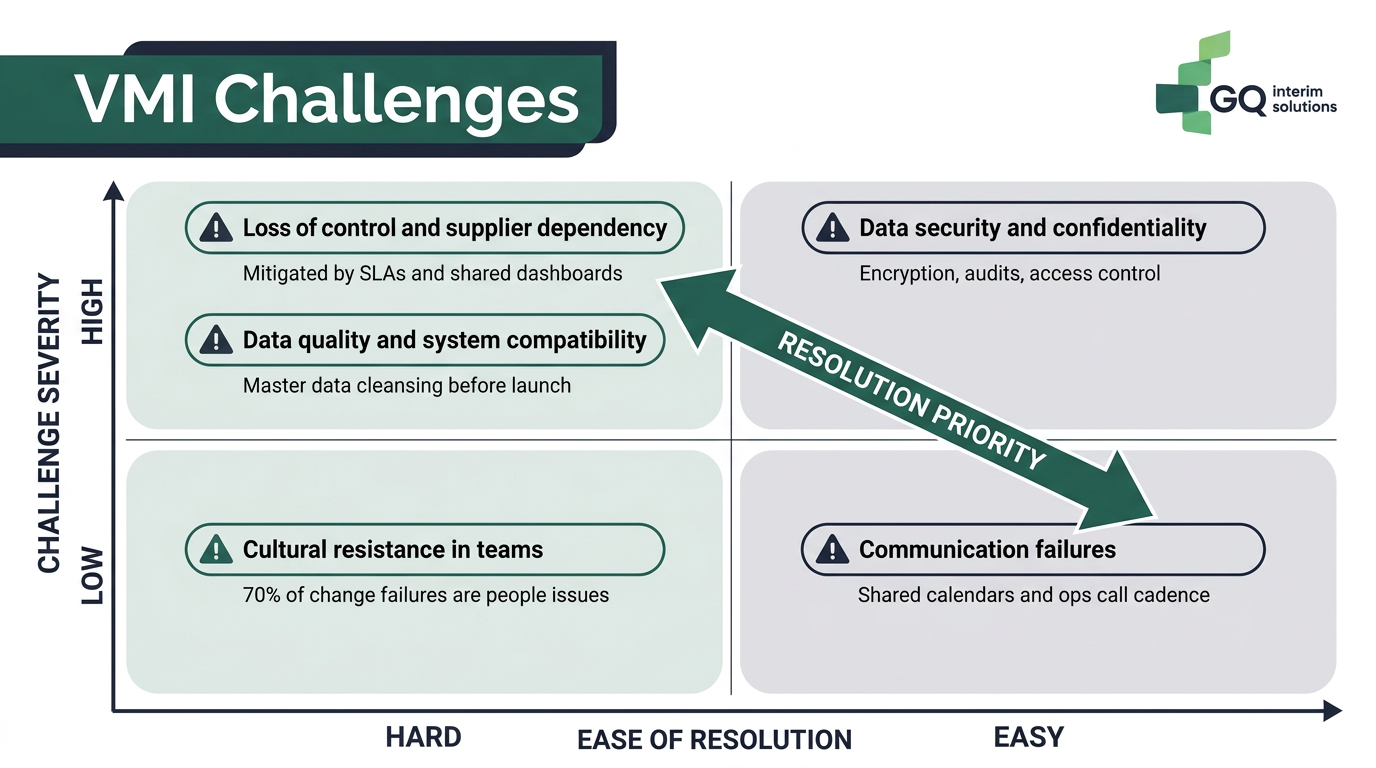
Vendor managed inventory brings real benefits, yet it also introduces non trivial risks if teams treat it as a simple outsourcing move. The main issues cluster around control, data, culture, and performance measurement. Each one can be managed with clear structure and the right skills.
One frequent concern is loss of control and dependency on a single supplier. Operations leaders may fear that moving decisions to the vendor leaves them blind during rush orders or emergencies. A clear contract with service level agreements (SLAs), escalation paths, and exit terms keeps both sides accountable. Shared dashboards in tools from providers such as Power BI or Tableau also keep visibility high for the buyer.
Data quality and system compatibility can easily block success. If item numbers, units of measure, or stock balances differ between systems, the vendor managed inventory model generates bad signals. Joint data cleansing before launch and careful master data governance across SAP, Oracle, or other platforms reduce this risk. Many firms ask an interim supply chain manager from GQ Interim to lead this clean up when internal teams lack time.
Communication failures often hurt even when systems work. A retailer may launch a big promotion without telling the supplier, which then triggers stockouts in stores. Regular operations calls, shared calendars for events, and simple rules about who informs whom when plans change help avoid these surprises. Tools like Microsoft Teams or Slack give a natural home for that daily exchange.
Data security and confidentiality matter when buyers share sales, margin, or production details. Both sides worry about leaks or misuse. Good practice includes strong identity management, encryption, and clear data usage clauses. Independent audits and guidance from firms like IBM Security give leaders extra confidence that their information is safe.
Inflexibility during sudden market shifts can also appear if algorithms rely too heavily on past patterns. Sharp demand spikes, as seen during recent semiconductor shortages, can catch VMI setups off guard. Adding manual override rules, safety buffers for high risk items, and scenario planning workshops can keep the model responsive.
Cultural resistance inside buyer and supplier teams is another major barrier. Planners may feel their role is under threat or distrust outside control. Research from McKinsey indicates that around 70 percent of large change programs falter mainly due to people and process issues rather than technology itself. Clear communication, training, and sponsorship from senior leaders, sometimes guided by interim experts from GQ Interim, help address these fears.
Finally, performance measurement can grow confusing if each party tracks different metrics. Buyers may focus on stock reduction while suppliers care more about volume. A jointly developed scorecard that covers inventory turns, fill rate, on time delivery, and financial impact keeps everyone focused on the same outcomes.
VMI in practice and industry applications and key KPIs to track
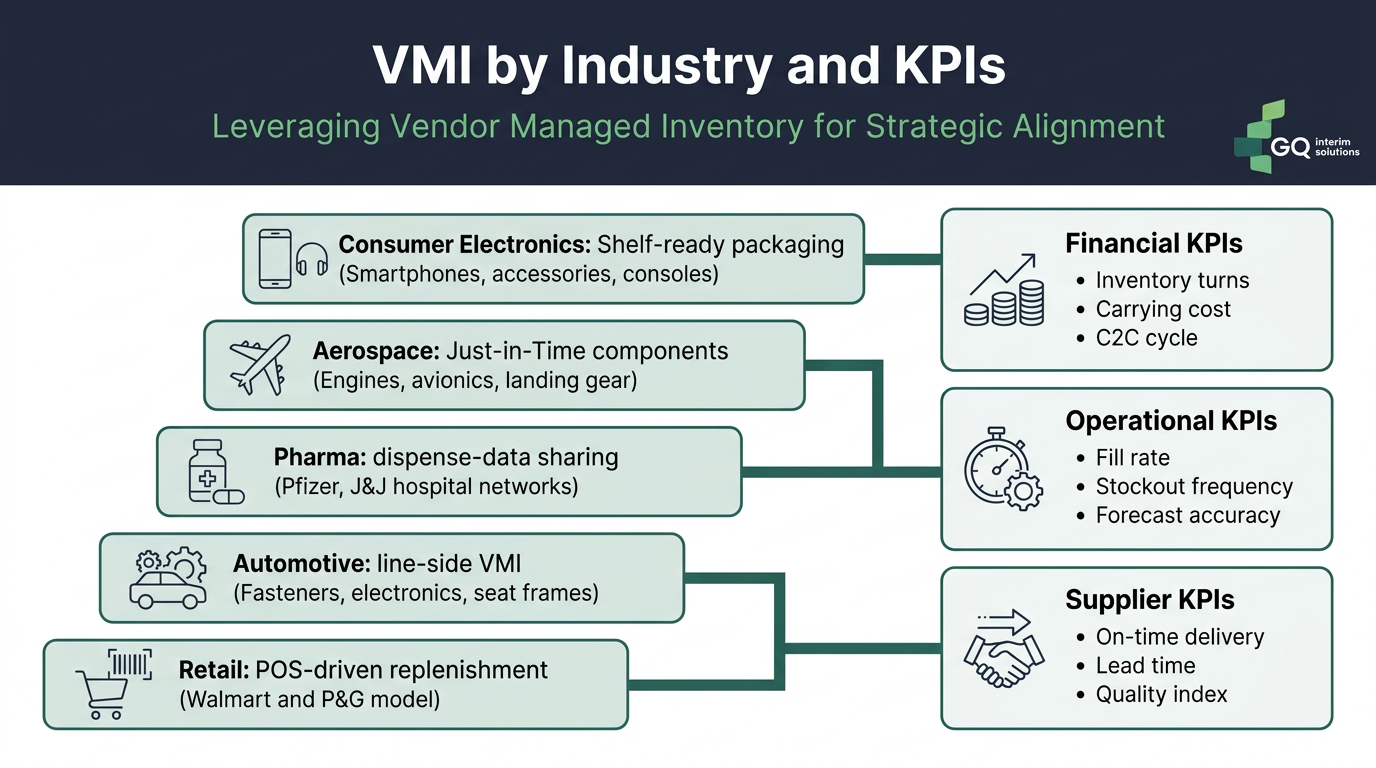
Vendor managed inventory is not just a theory for textbooks. It already shapes daily operations in plants, warehouses, and hospitals across the globe. Looking at real sectors makes the model easier to picture and gives clues on where to start.
Industry applications
Automotive manufacturing uses VMI to keep high runner parts such as fasteners, electronics, and seat frames ready at the line. Tier One suppliers serving companies like Stellantis or Volkswagen often store components in racks on site and refill them based on plant consumption. This approach reduces line stoppages and emergency freight while still limiting total stock.
Pharmaceuticals and healthcare apply vendor managed inventory to medicines and consumables where stockouts harm patient care. Hospital networks and pharmacy chains share dispense data with suppliers like Pfizer or Johnson & Johnson to maintain target levels without hoarding. Temperature controlled storage and strict tracking rules add an extra layer of discipline to the program.
Retail and consumer packaged goods companies, including Walmart and Procter & Gamble, rely on VMI to keep shelves stocked without drowning in excess. Suppliers receive point of sale data from thousands of stores and adjust shipments by region. This supports promotions while keeping overall inventory in check.
Food and beverage firms use VMI for perishable goods where waste eats profit. Brewers and bottlers that supply restaurant chains or supermarket groups watch withdrawal data closely to send the right mix of products. Short shelf life forces tight cycles and rewards accurate forecasting.
Aerospace and heavy industry apply VMI to maintenance, repair, and overhaul parts. Airlines and firms like Boeing or Airbus work with component suppliers to keep spares on hand at hubs or maintenance bases. This setup reduces aircraft downtime, which can cost tens of thousands of dollars per hour according to IATA.
Key KPIs to track
Financial KPIs focus on whether VMI is paying off. Leaders watch inventory turnover rate, overall inventory value, and inventory carrying cost as a percent of inventory. Cash to cash cycle time shows how the program affects working capital. Regular review with finance partners keeps attention on real savings, not just stock moving between books.
Operational KPIs track service and flow. Order fill rate, stockout frequency, and backorder rate reveal whether customers receive what they need. Forecast accuracy and schedule adherence help teams see if data and planning models work as expected. These measures link directly to plant uptime and customer satisfaction.
Supplier performance KPIs measure how well vendors play their part. On time delivery rate and supplier lead time show reliability. A supplier quality index that bundles defect rate, delivery performance, and responsiveness gives a fair picture of partner health. According to Supply Chain Quarterly, firms that track these metrics consistently tend to build stronger long term supplier ties.
“What gets measured gets managed.” — Peter Drucker
How GQ Interim helps you implement VMI and optimize your supply chain
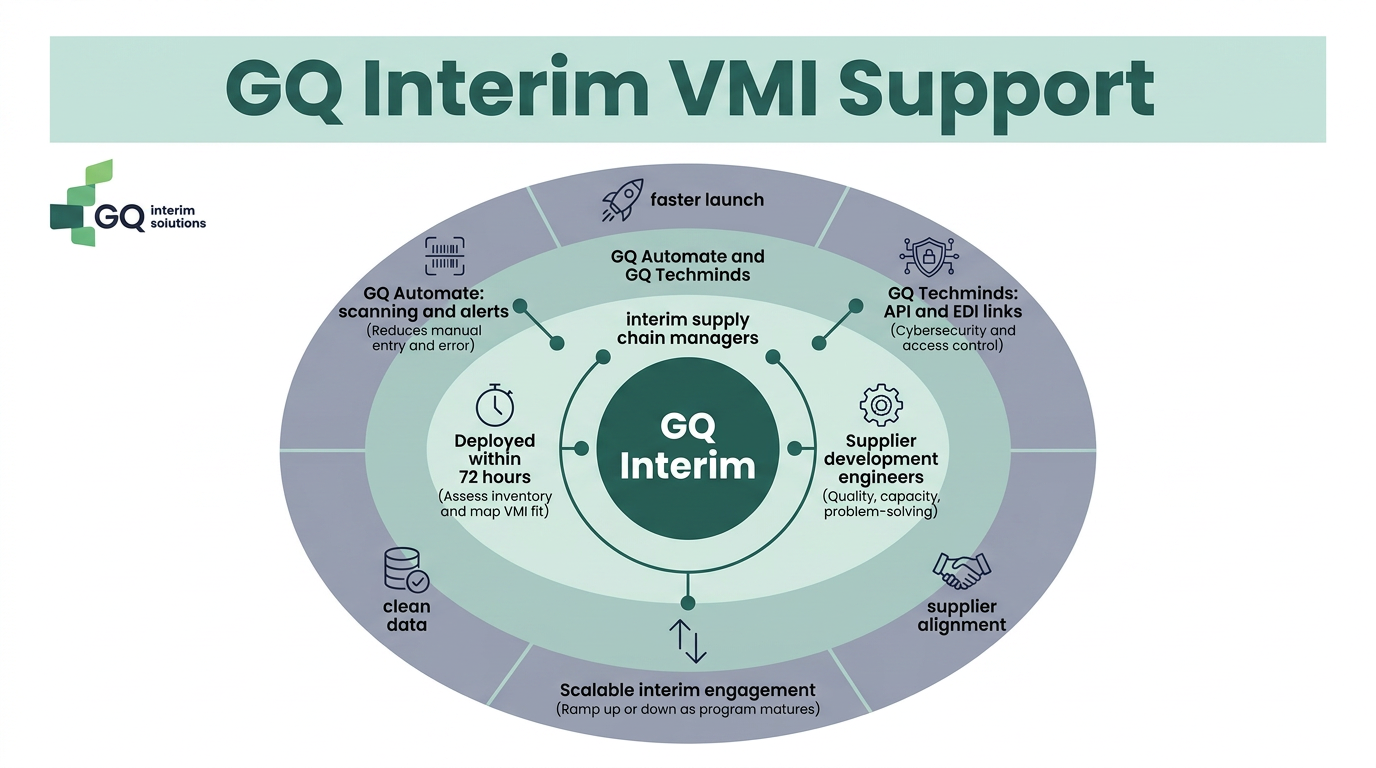
Many organizations like the theory of vendor managed inventory but stall when they reach detailed design and rollout. Internal leaders may be overloaded, and the mix of process, technology, and supplier negotiation can feel heavy. GQ Interim steps into that gap so progress continues without waiting for permanent hires.
GQ Interim maintains a network of more than ten thousand consultants across logistics, supply chain engineering, procurement, automation, and IT. Interim supply chain managers can arrive within seventy two hours to assess current inventory practices and map which items fit a vendor managed inventory model. They then steer workshops with key suppliers, finance, and IT to agree scope, service levels, and clear contracts.
GQ Interim provides interim logistics and inventory experts who focus on real time stock tracking and low level alerts. These specialists set up simple dashboards so operations managers and plant leaders can see stock risk before it bites production. During the early months of a VMI program, they watch data closely and fine tune parameters so the system settles quickly.
Through its GQ Automate service, GQ Interim advises on automation that supports VMI, such as barcode scanning, automated counting, and electronic delivery notifications. Consultants work with existing platforms, whether SAP, Oracle, or cloud tools, to reduce manual entry and error. This helps the vendor managed inventory model rely on clean, timely data rather than spreadsheets.
GQ Techminds, the IT and digital unit within GQ Interim, supports system integration and cybersecurity for VMI programs. Their teams design and oversee API or EDI connections between buyer ERP systems and supplier tools, with strong access control and encryption. That reduces the risk of leaks while still giving suppliers the insight they need.
Supplier development engineers from GQ Interim help strengthen partner performance so VMI can succeed. They visit supplier plants, review quality and capacity, and support problem solving when delivery issues appear. Clients such as MAGNA Electronics and Lear Corporation Seating highlight how quickly GQ Interim experts integrated with their teams and kept projects on track.
Because GQ Interim works on an interim model, organizations can ramp support up or down as the vendor managed inventory program moves from design into steady state. This flexibility lets leaders respond to disruptions without locking into long hiring cycles.
The bottom line
Vendor managed inventory gives suppliers direct responsibility for stock at customer sites, supported by shared data and clear agreements. When set up with the right technology, KPIs, and supplier relationships, it can cut carrying cost, reduce stockouts, and smooth production for both sides. The model will not fix every problem on its own, but it provides a strong base for more stable and data driven supply chains.
For leaders in manufacturing, automotive, logistics, and healthcare, the hardest part is often finding time and expertise to start. Interim managers and specialists from GQ Interim bring hands on experience with VMI design, system integration, and supplier alignment, often within days. If your organization is considering vendor managed inventory or already faces disruptions from weak inventory control, visit gqinterim.com to request support and move faster toward a more reliable supply chain.
Frequently asked questions
Question 1: What is the difference between vendor managed inventory and consignment inventory?
Vendor managed inventory means the supplier monitors stock levels and decides when to replenish using shared data. Consignment inventory means the supplier owns the goods at the buyer site until use but may not manage restocking decisions actively. Some programs use both ideas together when suppliers own stock and also run VMI, yet ownership and management remain separate concepts.
Question 2: What does vendor owned inventory mean?
Vendor owned inventory means the supplier keeps legal ownership of goods stored at the customer location until the goods are sold or consumed. The buyer holds the items physically but does not record them as assets until use. This ownership setup often appears together with vendor managed inventory, yet VMI refers mainly to how replenishment decisions are made, not who owns the stock.
Question 3: Is VMI suitable for small and mid sized businesses?
Yes, VMI can fit small and mid sized firms, especially where demand is steady and items move often. Many SMBs start by placing only a handful of high impact items under vendor managed inventory to limit risk. Cloud based platforms and standard EDI or API links make the technology side lighter. Interim experts from GQ Interim can guide design so smaller teams are not overloaded.
Question 4: How long does it typically take to implement a VMI program?
Simple VMI programs for a narrow item range can start running in a few weeks once data and agreements are ready. Broader programs that cover many SKUs and full ERP integration often take several months. Timelines shorten when experienced interim supply chain managers lead the work, since they know common pitfalls and can coordinate suppliers, IT, and finance more quickly.
Question 5: What is the bullwhip effect and how does VMI help reduce it?
The bullwhip effect describes how small shifts in end customer demand turn into large swings in orders and production further upstream. Vendor managed inventory reduces this by giving suppliers direct access to real demand data instead of delayed purchase orders. When a supplier sees true consumption from systems such as SAP or point of sale feeds, production plans reflect reality more closely, and swings calm down.
