


- Evaluation and decision-making tools
- Multivoting
- When to use multivoting
- Multivoting procedure
Evaluation and decision-making tools
Use evaluation and decision-making tools when you want to narrow a group of choices to the best one, or when you want to evaluate how well you’ve done something. This includes evaluating project results.
- Multivoting: Narrows a large list of possibilities to a smaller list of the top priorities or to a final selection; allows an item that is favored by all, but not the top choice of any, to rise to the top.
- Decision matrix: Evaluates and prioritizes a list of options, using pre-determined weighted criteria.
Multivoting
Also called: NGT voting, nominal prioritization.
Variations: sticking dots, weighted voting, multiple picking-out method (MPM).
Multivoting narrows a large list of possibilities to a smaller list of the top priorities or to a final selection. Multivoting is preferable to straight voting because it allows an item that is favored by all, but not the top choice of any, to rise to the top.
When to use multivoting
- After brainstorming or some other expansion tool has been used to generate a long list of possibilities
- When the list must be narrowed down
- When the decision must be made by group judgment
Multivoting procedure
- Materials needed: A flipchart for whiteboard, marking pens, 5 to 10 slips of paper for each individual, pen or pencil for each individual.
- Display the list of options. Combine duplicate items. Affinity diagrams can be useful to organize large numbers of ideas and eliminate duplication and overlap. List reduction may also be useful.
- Number (or letter) all items.
- Decide how many items must be on the final reduced list. Decide also how many choices each member will vote for. Usually, five choices are allowed. The longer the original list, the more votes will be allowed, up to 10.
- Working individually, each member selects the five items (or whatever number of choices is allowed) he or she thinks most important. Then each member ranks the choices in order of priority, with the first choice ranking highest. For example, if each member has five votes, the top choice would be ranked five, the next choice four, and so on. Each choice is written on a separate paper, with the ranking underlined in the lower right corner.
- Tally votes. Collect the papers, shuffle them, then record on a flipchart or whiteboard. The easiest way to record votes is for the scribe to write all the individual rankings next to each choice. For each item, the rankings are totaled next to the individual rankings.
- If a decision is clear, stop here. Otherwise, continue with a brief discussion of the vote. The purpose of the discussion is to look at dramatic voting differences, such as an item that received both 5 and 1 ratings, and avoid errors from incorrect information or understandings about the item. The discussion should not result in pressure on anyone to change their vote.
- Repeat the voting process in steps 4 and 5. If greater decision-making accuracy is required, this voting may be done by weighting the relative importance of each choice on a scale of 1 to 10, with 10 being most important.
Download our e-book
Download our free e-book to discover how GQ Interim can transform your business with expert leadership solutions!
Multivoting example
A team had to develop a list of key customers to interview. First, team members brainstormed a list of possible names. Since they wanted representation of customers in three different departments, they divided the list into three groups. Within each group, they used multivoting to identify four first-choice interviewees. This example shows the multivoting for one department.
Fifteen of the brainstormed names were in that department. Each team member was allowed five votes, giving five points to the top choice, four to the second choice, and so on down to one point for the fifth choice. The votes and tally are shown in Figure 1. (The names are fictitious, and any resemblance to real individuals is strictly coincidental.) Although several of the choices emerge as agreed favorites, significant differences are indicated by the number of choices that have both high and low rankings. The team will discuss the options to ensure that everyone has the same information, and then vote again.
Votes in rank order:
- Rhonda’s votes: 4, 9, 12, 2, 8
- Terry’s votes: 6, 10, 12, 9, 15
- Pete’s votes: 2, 9, 14, 4, 6
- Martha’s votes: 10, 8, 15, 12, 11
- Al’s votes: 8, 6, 11, 10, 4
1. Buddy Ellis
2. Susan Legrand 2+5=7
3. Barry Williams
4. Lisa Galmon 5+2+1=8
5. Steve Garland
6. Albert Stevens 5+1+4=10
7. Greg Burgess
8. Joan McPherson 1+4+5=10
9. Donald Jordan
10. Sam Hayes 4+5+2=11
11. Mike Frost 1+3=4
12. Luke Dominiguez 3+3+2=8
13. Joe Modleski
14. Paul Moneaux 3
15. Chad Rush 1+3=4
Conclusion
Multivoting is more than just a way to reduce a long list of ideas—it’s a structured tool for surfacing collective priorities while preserving individual input. As demonstrated in the example, even when clear favorites emerge, differences in voting highlight the importance of group discussion before finalizing decisions. This method not only brings clarity to complex choices but also fosters transparency and alignment within teams. When used thoughtfully, multivoting can turn a brainstorming session into actionable consensus.
Interested in Interim Expert?
Discover how interim management can dramatically increase the efficiency of your business. Get in touch with our team to learn how working with GQ Interim will improve your company.
- Get started within few days
- Database of 10 000+ consultants
- Solving crucial problems of your business
- Custom solutions for your business needs
- Proven results with measurable impact
Related articles
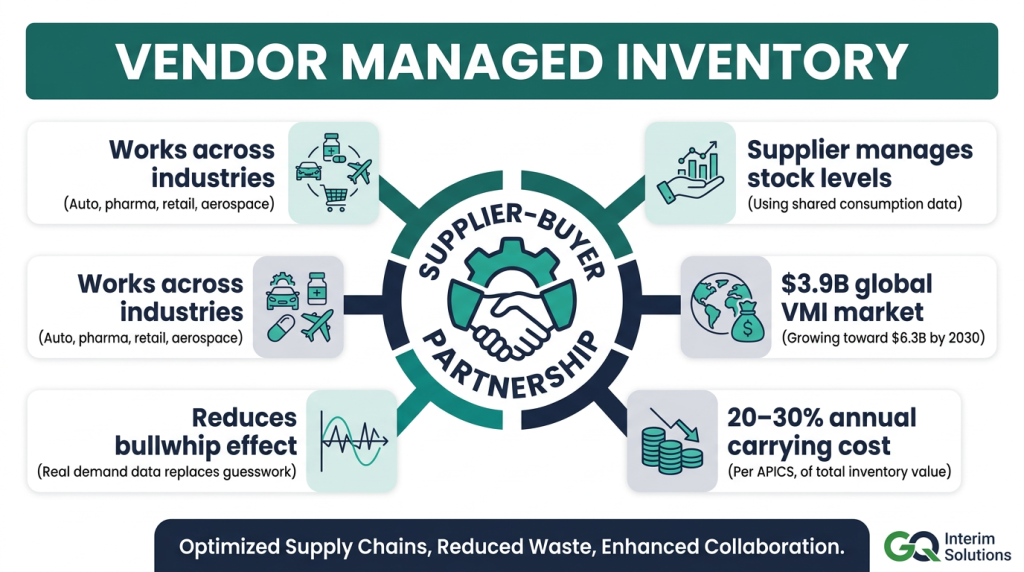
- Wondering if Vendor Management Inventory is right for your plant or network? This guide unpacks how VMI works, where it delivers savings and stability, the pitfalls to avoid, and the KPIs and tech you need to stay in control.

- Managing every supplier the same way rarely delivers the best results. Supplier segmentation helps businesses prioritize supplier relationships, reduce risk, and focus procurement efforts where they create the greatest value.

- Hiring a senior sales leader is one of the most important decisions a growing business can make. Learn how sales executive search works, when it's the right choice, and why it consistently delivers stronger long-term hiring outcomes than traditional recruitment.

- Great products don't happen by accident. Behind every successful product is strong leadership that aligns business strategy, customer needs, and cross-functional teams. Discover what product leadership involves, why it matters, and how it helps businesses make better product decisions.
