
EVOP, or evolutionary operation, is a method for improving a running process without stopping production. Operators make small, planned changes to two or three process settings, stay inside the specification, repeat the cycle and use simple statistics to see which direction gives better results. George Box introduced it in 1957.
Classic experiments are powerful, but they cost money, need trained people and often interrupt production. EVOP takes the opposite approach. The process keeps making good parts, and every batch also produces data that shows how to make the process better.
This guide explains what EVOP is, why it is useful, how an EVOP cycle works step by step, where its limits are and how it compares with design of experiments, SPC and Six Sigma.
- EVOP improves a full-scale process during normal production, with changes so small that the product stays within specification.
- The standard design changes two factors around the current operating point: five settings per cycle, repeated until the effects are clear.
- EVOP is cheap and safe, but slow. It suits fine-tuning a stable process, not finding the cause of a sudden quality problem.
- It works when operators run it, a small team reviews the results regularly and every setting stays inside the approved process window.
What is EVOP?
Evolutionary operation was introduced by the statistician George E. P. Box, who developed it at Imperial Chemical Industries and published it in 1957. In 1969 he and Norman Draper described the method in detail in the book Evolutionary Operation.
EVOP is based on a simple idea: a process produces products, and it can also produce information about how to improve itself. Instead of running at one fixed setting, the process runs in a continuous, systematic pattern of small deviations from the current setting. Because the changes are small, the products stay within specification. Because the pattern is repeated many times, the data become reliable enough to show which change improves the result.
EVOP replaces static operation of a process with a routine of small, planned changes to its settings, so that the process keeps making good products while the team learns which direction improves it.
Why use EVOP instead of a classic experiment?
Classic design of experiments helps you find the best combination of process factors and their levels. It is a very strong tool, but it costs money and manpower, needs special training and often stops production. EVOP turns improvement into the normal way the plant operates.
How does an EVOP cycle work?
The standard EVOP design uses two factors, for example a temperature and a pressure. Around the current operating point you set a small step, called D, that still produces good parts. One cycle runs the process once at each of five settings: the current point and the four corners of a small square around it.
| Setting | Factor X | Factor Y | Role |
|---|---|---|---|
| 1 | X | Y | Current operating point, center |
| 2 | X minus D | Y minus D | Low X, low Y |
| 3 | X plus D | Y plus D | High X, high Y |
| 4 | X plus D | Y minus D | High X, low Y |
| 5 | X minus D | Y plus D | Low X, high Y |
- Choose the response and the factorsPick one result that matters, such as yield, scrap rate or a key dimension, and two process settings that probably affect it.
- Set a safe step sizeChoose D so small that every setting still produces products within specification and inside the approved process window.
- Run the cycleRun the process at all five settings and record the result for each one. Then repeat the same cycle again and again.
- Calculate the effectsAfter each cycle, update the averages and calculate the effect of each factor and of the change in mean, then compare them with the error limits.
- Move the centerWhen an effect is clearly larger than its error limit, move the operating point in the better direction. This ends one phase and starts the next.
- Review and standardizeA small team reviews the results regularly. When no further gain appears, the best setting becomes the new standard.
The calculation is simple enough for a worksheet. The effect of factor X is the average result at high X minus the average result at low X. The effect of factor Y is calculated the same way. The interaction shows whether the effect of X depends on the level of Y. The change-in-mean effect compares the four corners with the center and shows whether the center is already close to the best point.
Each effect is compared with an error limit of about two standard errors, which gets smaller with every cycle. While an effect is smaller than its limit, the team keeps running cycles. Once it is larger, the effect is real and the team can act on it. A phase often needs several cycles, because the changes are small and process noise hides them at first.
Single-factor EVOP
Take the current production level X as the center. Decide which levels X minus D and X plus D still give good products within the specification limits. Run the process at all three levels, evaluate the quality at each one and move toward the level that gives the best result.
Two-factor EVOP
This is the most common design, described above. Evaluate the output at every combination of X and Y with the step D. The combination that gives the best quality becomes the new center point for the next phase.
Three-factor EVOP
The same logic with three factors, usually a cube of eight corner settings plus the center. It gives more information per phase, but each cycle takes longer and the data are harder to manage on the shop floor. Most plants start with two factors.
What does an EVOP example look like in a plant?
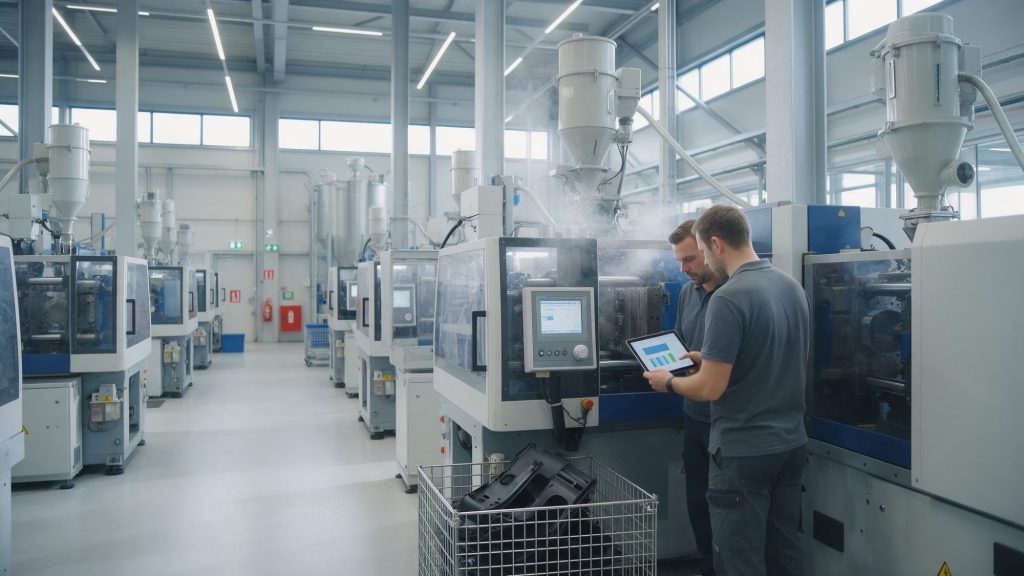
Here is an illustrative example, not a client case. An injection molding line makes a plastic housing. Scrap from short shots and sink marks is acceptable, but higher than the plant wants. The team chooses scrap rate as the response, and melt temperature and holding pressure as the factors.
The engineer sets the steps at 5 °C and 20 bar, so all five settings stay inside the validated window in the control plan. Operators run each setting for one batch in every shift, write the scrap count on a simple board and the engineer updates the averages. After several cycles the effect of holding pressure is larger than its error limit, while melt temperature shows no clear effect. The team moves the center to the higher pressure and starts the next phase from there.
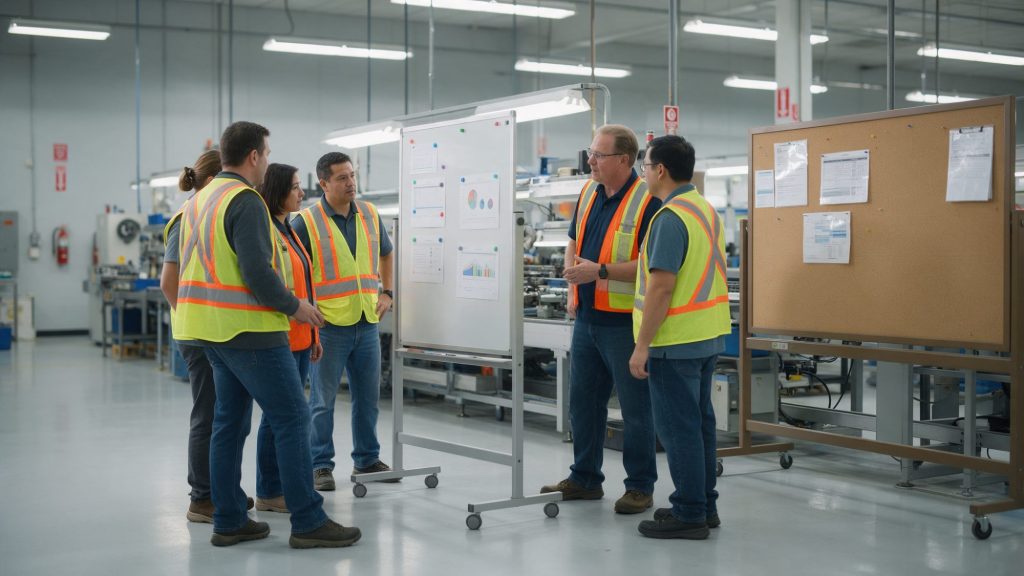
Keep the results visible at the line on an information board, as Box and Draper recommended: current averages, effects and error limits. Operators then see the process learning, and a short regular review by a small EVOP team keeps decisions moving.
The interim management guide for manufacturing companies
When an experienced interim manager is the fastest way to restart improvement work and get results that last.
- When an interim manager pays off
- How to write a mandate
- The first 30 days, week by week
What are the advantages and disadvantages of EVOP?
EVOP is useful in manufacturing and in service processes, because it generates ideas for improvement and helps establish cause and effect. It also has clear limits.
- Advantage: no lost output. The process keeps producing good products during the whole study.
- Advantage: low cost and low risk. Small steps inside the specification mean no scrap from extreme trial settings.
- Advantage: built into daily work. Operators run it, so improvement does not depend on a separate project team.
- Advantage: it follows a drifting process. Because cycles repeat, EVOP keeps tracking the best setting when raw materials or equipment change.
- Disadvantage: slow. Small changes produce small effects, so many cycles are needed before a decision.
- Disadvantage: few factors. Two or three factors at once is the practical limit.
- Disadvantage: local optimum. EVOP finds a better point near the current one, not a radically different process.
- Disadvantage: discipline. Results fade if settings are not followed exactly or data are not recorded in every cycle.
EVOP vs DOE, RSM, SPC and Six Sigma: what is the difference?
EVOP belongs to the same family as design of experiments, but it has a different purpose. The right choice depends on whether you can stop the process and how much you already know about it.
| Method | Where it runs | Size of changes | Best for |
|---|---|---|---|
| EVOP | Full-scale production, during normal operation | Small, inside specification | Fine-tuning a stable process step by step |
| Design of experiments, DOE | Pilot runs or planned trials, often with a production stop | Large, to see clear effects | Finding the important factors quickly |
| Response surface methodology, RSM | Planned trials after a screening DOE | Medium, several levels | Modeling and finding an optimum precisely |
| Statistical process control, SPC | Full-scale production | No intentional changes | Detecting when a process goes out of control |
| Six Sigma, DMAIC | Project over several months | Depends on the tools used | Solving a complex problem with unclear causes |
| Taguchi methods | Planned trials | Large, chosen levels | Making a design less sensitive to noise |
These methods work well together. A DOE can find the important factors, and EVOP can then keep improving them in production. SPC watches that the improved process stays stable. In a Six Sigma project, EVOP fits the Improve and Control phases. For a structured way through a quality problem, see structured problem solving with PDCA, 8D and A3.
How do you run EVOP safely on a production line?
The main risk in EVOP is not the statistics. It is a change that leaves the approved process window or confuses the shift. Before the first cycle, check these points:
- Every setting is inside the approved process window in the control plan and the specification.
- Safety limits of the equipment are checked with maintenance and the process owner.
- Each setting has a clear run card: values, batch size and what to record.
- Every shift is trained and knows which setting to run and when.
- Product made at each setting stays traceable to that setting.
- One person owns the calculations, and the EVOP team reviews them on fixed dates.
Keep every EVOP setting inside the ranges approved in your control plan. Moving the operating point outside them is a process change. In automotive and other regulated industries that usually means formal change management and may need customer approval.
Modern plants have an advantage that Box did not have. Process data from machines, MES and SCADA systems can fill the worksheet automatically, so the team spends less effort on recording and more on decisions. The method stays the same: small planned changes, repeated cycles and a decision only when the effect is clear.
How does an interim manager help EVOP deliver results?
Many plants in Central and Eastern Europe have stable processes with known losses, but nobody has the capacity to run a disciplined improvement routine. An experienced interim process engineer, quality manager or Six Sigma Black Belt can set up EVOP, define safe step sizes with the process owner, train the operators and hand over a working routine to the permanent team.
EVOP fits well with other continuous improvement work. Read about the benefits of kaizen and kaizen events, and how a weighted decision matrix helps the team choose which process to improve first. To bring in outside support, see what an interim manager does and our interim quality manager service.
How GQ Interim helps
Since 2011 we have completed more than 1,550 projects in manufacturing and industrial companies across Central and Eastern Europe, for clients such as Stellantis, Porsche, Siemens, Valeo and Magna. Our database holds 7,500+ verified experts in quality, process engineering, operations and plant management. We are certified to ISO 9001 and TISAX.
Conclusion
EVOP gives a plant a low-cost, low-risk way to improve a process that is already running. Small, systematic changes inside the approved window produce data without stopping production, and repeated cycles turn that data into clear decisions.
It is not the fastest method, and it does not replace DOE or structured problem solving. But for a stable process with known losses, it builds a habit of continuous improvement and gives operators a real understanding of cause and effect.
Improve your running processes this quarter
Tell us which line or process needs better results. We come back with quality and process experts who have done it before.
Frequently asked questions
What is EVOP?
EVOP, or evolutionary operation, is a method for improving a full-scale process during normal production. Small, planned changes to two or three settings are repeated in cycles, and simple statistics show which direction improves the result while the product stays within specification.
Who developed evolutionary operation?
The statistician George E. P. Box developed EVOP at Imperial Chemical Industries and published it in 1957. With Norman Draper he described it in detail in the 1969 book Evolutionary Operation.
What is the difference between EVOP and DOE?
A classic design of experiments uses large changes in planned trials, often with a production stop, to find the important factors quickly. EVOP uses small changes during normal production and needs more cycles, but it produces no scrap from extreme settings.
What is an EVOP cycle and an EVOP phase?
A cycle runs the process once at every setting of the design, for example five settings in a two-factor EVOP. A phase is a series of cycles at the same center point. It ends when an effect is clearly larger than its error limit and the center is moved.
How are EVOP effects and error limits calculated?
The effect of a factor is the average result at its high level minus the average at its low level. Each effect is compared with an error limit of about two standard errors, which gets smaller as more cycles are run. An effect larger than its limit is treated as real.
What are the main disadvantages of EVOP?
EVOP is slow, because small changes produce small effects. It handles only two or three factors at once, finds a better point near the current one rather than a new process, and needs discipline in following settings and recording data.
When should you use EVOP?
Use EVOP on a stable process that cannot be stopped for trials, when the important factors are roughly known and the goal is to improve yield, scrap or cost step by step. For a sudden quality problem, start with structured problem solving instead.
What is simplex EVOP?
Simplex EVOP is a variant proposed by Spendley, Hext and Himsworth in 1962. Instead of a square of settings it uses a simplex, a triangle for two factors, and moves by replacing the worst setting with a new one. It handles more factors with fewer runs.
Can EVOP be used in automotive production?
Yes, as long as every setting stays inside the process window approved in the control plan. Moving the operating point outside that window is a process change and usually needs formal change management and possibly customer approval.