


- Development of Jidoka
- Concept of Jidoka
- The evolution and impact of Jidoka
What is Jidoka?
Jidoka comes from the Toyota Production system and is very often forgotten even while it is one of the most important principles of lean. Jidoka is about quality at source or built in quality. There is no company which could be competitive without excellent quality of product and service and jidoka is the way how can be this achieved.
Development of Jidoka
Jidoka was invented by Sakichi Toyoda (Founder of the Toyota Group) in 1896 by a simple device that could stop the shuttle on an automatic loom if the thread broke.
This meant that it prevented the machine from not only creating defects but also warned the operator to a problem. This gave the possibility to one operator to operate several looms and not to stand only at one machine and to watch if something goes wrong. This principle became known as Autonomation or automation with a human touch.
The Toyota term “jido” is applied to a machine with a built-in device for making judgments, whereas the regular Japanese term “jido” (automation) is for a machine that works on its own. Jidoka refers to automation with a human touch, as opposed to a machine that simply moves under the monitoring and supervision of an operator.
Download our e-book
Download our free e-book to discover how GQ Interim can transform your business with expert leadership solutions!

Principles of Jidoka
The principle of Jidoka is divided into 4 steps:
- Discover an abnormality
- Stop
- Fix the immediate problem
- Investigate and correct root cause
The benefit of jidoka is its utilization. Is not used only within machines through autonomation, is also visible in almost every aspect of lean manufacturing when you start to examine it. It is about building quality into a process rather than inspecting for it at the end of the process.
The first step of jidoka is to detect the abnormality, so for autonomation the machine uses simple sensors to detect a problem and then stops and highlights the problems for the operator.
For line stop the operator detects an abnormality and stops the line and highlights the problem for all to see on an andon board.
Since the loom stopped when a problem arose, no defective products were produced. This meant that a single operator could be put in charge of numerous looms, resulting in a tremendous improvement in productivity.
Since equipment stops when a problem arises, a single operator can visually check and monitor many machines. As an important tool for this visual control is suitable the problem display board system called andon which is used by Toyota plants. This system allows the operators to identify problems in the production line with only a glance.

Conclusion
Jidoka is a powerful Lean principle that ensures quality is embedded in every step of the production process. By empowering machines and people to detect problems early, stop operations, and resolve root causes, Jidoka prevents defects from accumulating and enables continuous improvement. Far from being just an automation strategy, it represents a culture of responsibility, transparency, and built-in quality. When applied correctly, Jidoka leads to fewer errors, greater efficiency, and stronger customer satisfaction—making it essential for any organization committed to excellence.
Interested in Interim Expert?
Discover how interim management can dramatically increase the efficiency of your business. Get in touch with our team to learn how working with GQ Interim will improve your company.
- Get started within few days
- Database of 10 000+ consultants
- Solving crucial problems of your business
- Custom solutions for your business needs
- Proven results with measurable impact
Related articles
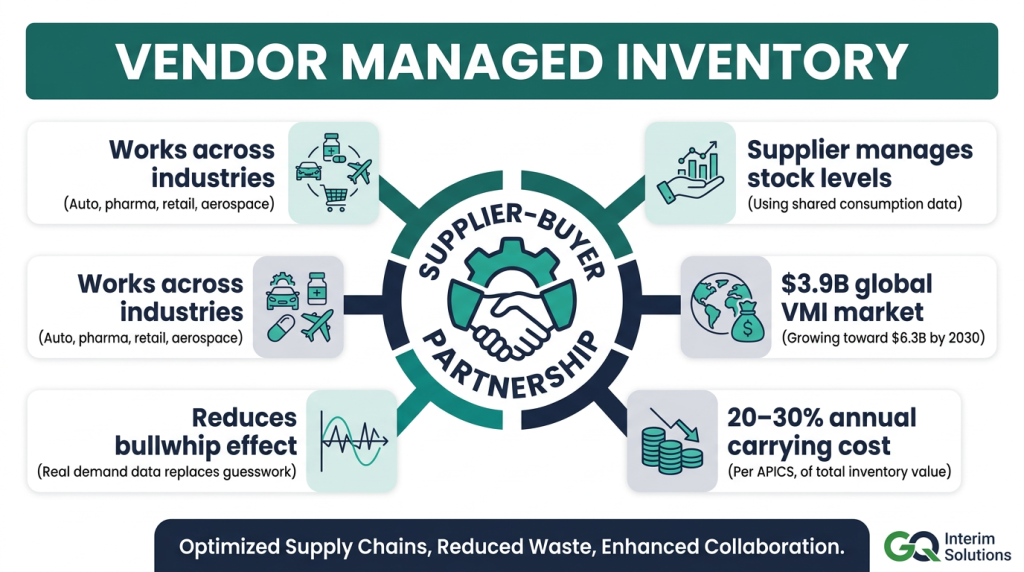
- Wondering if Vendor Management Inventory is right for your plant or network? This guide unpacks how VMI works, where it delivers savings and stability, the pitfalls to avoid, and the KPIs and tech you need to stay in control.

- Managing every supplier the same way rarely delivers the best results. Supplier segmentation helps businesses prioritize supplier relationships, reduce risk, and focus procurement efforts where they create the greatest value.

- Hiring a senior sales leader is one of the most important decisions a growing business can make. Learn how sales executive search works, when it's the right choice, and why it consistently delivers stronger long-term hiring outcomes than traditional recruitment.

- Great products don't happen by accident. Behind every successful product is strong leadership that aligns business strategy, customer needs, and cross-functional teams. Discover what product leadership involves, why it matters, and how it helps businesses make better product decisions.
