


- How to conduct a gemba visit
- Customer segments table – example for a flashlight
- Defining customer needs
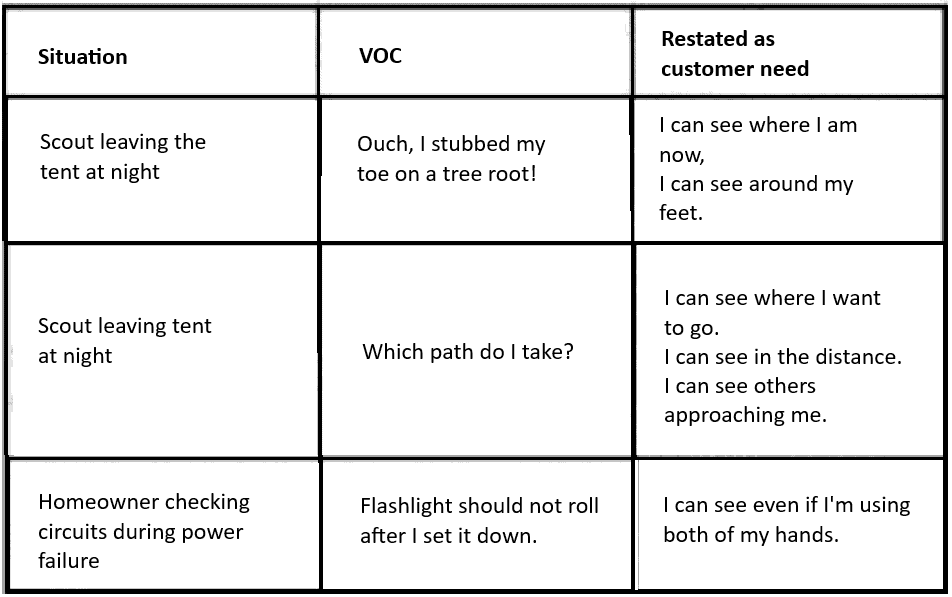
- Example of customer voice table
The first step is to capture the voice of the customer (VOC). Common sources can include sales and technical trip reports, warranty claims, user support forums or help lines, and social media. Among the well-known market research methods available, surveys and focus groups can be useful for validating what an organization already presumes to know about customer needs.
Questionnaires can help capture new information an organization knows to exist and specifically seeks. These methods are scripted by the organization and typically address questions about a product or service.
In contrast, customer gemba visits are unique to QFD. A gemba visit involves listening to and observing customers while they are using a product or service to determine what they are doing (or failing to do). During these moments, organizations can uncover information that they did not even know existed and would not know to seek.
How to conduct a gemba visit
- Select which customers are most important to visit. List each segment in one row of a customer segments table, as shown in the table below.
- Define the conditions of the visit. You want to be present at the most stressful time for the customer. After all, if your product or service does not help solve your customers’ most urgent needs, why would they purchase it?
- Capture what you learn.

How to Translate VOC into Customer Needs
Customers do not always explain their needs completely and accurately. In fact, often they speak about whatfeatures they want for a product or service. To be innovative, an organization needs to know why customers want certain features. Understanding customer needs at this level enables an organization to develop new solutions before its competitors can.
Voice of the customer information gathered from market research methods, gemba visits, or other means should therefore be restated into customer needs. Use a customer voice table and follow these steps to translate VOC into needs:
Document each VOC statement and the situation or context in which it was made.
Ask customers to try to restate their input in terms of their needs. Features, especially, should be translated into needs. It is not uncommon to derive as many as five to ten needs from one VOC statement. Unspoken needs will emerge.
Have customers prioritize their needs. For accurate ratio scale priorities that can be properly used in later QFD matrices, the analytic hierarchy process (AHP)should be used.
Defining customer needs
In QFD, information that meets the following criteria can be considered to express a true customer need:
- Defines the benefit customers receive from
- their problems solved
- their opportunities enabled
- their image enhanced
- Is positively stated
- Focuses on a single issue
- Is independent of specific products or services, features, and technologies
Once customers have prioritized their needs, the QFD team can work on identifying product features that will have the greatest impact. In this example, if “I can see around my feet” has the highest priority for the flashlight, then it might make sense to add a second bulb that points downward and has a focal length for a five-foot-tall scout.
Download our e-book
Download our free e-book to discover how GQ Interim can transform your business with expert leadership solutions!
Conclusion
The Voice of the Customer (VOC) table is a foundational tool in quality function deployment, helping organizations move beyond assumptions and into actionable insight. By observing real-world behavior through methods like gemba visits and translating feedback into prioritized customer needs, teams can design solutions that truly resonate. When applied correctly, VOC-driven development doesn’t just improve products—it creates meaningful value, strengthens customer loyalty, and gives organizations a decisive edge in competitive markets.
Interested in Interim Expert?
Discover how interim management can dramatically increase the efficiency of your business. Get in touch with our team to learn how working with GQ Interim will improve your company.
- Get started within few days
- Database of 10 000+ consultants
- Solving crucial problems of your business
- Custom solutions for your business needs
- Proven results with measurable impact
Related articles
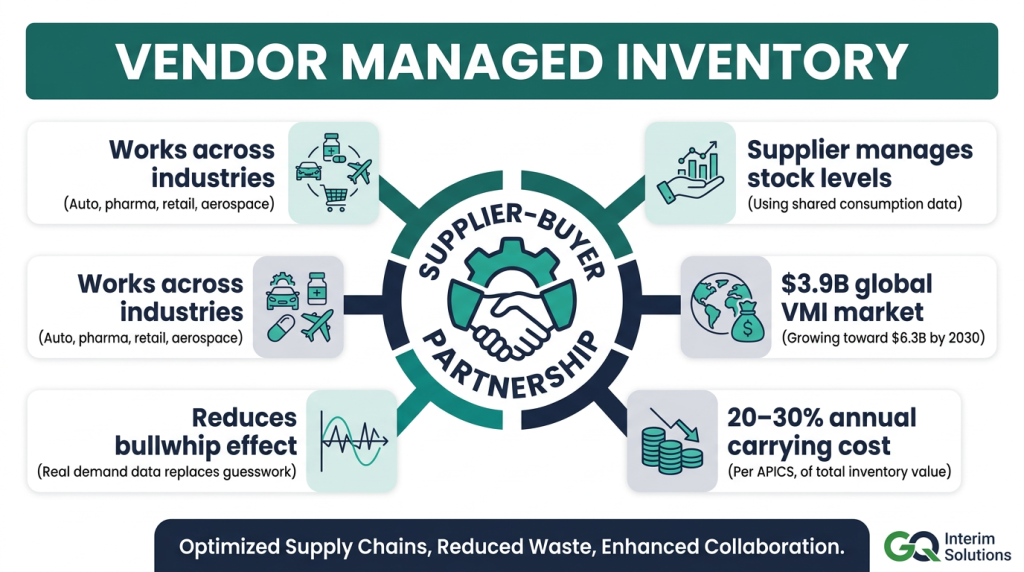
- Wondering if Vendor Management Inventory is right for your plant or network? This guide unpacks how VMI works, where it delivers savings and stability, the pitfalls to avoid, and the KPIs and tech you need to stay in control.

- Managing every supplier the same way rarely delivers the best results. Supplier segmentation helps businesses prioritize supplier relationships, reduce risk, and focus procurement efforts where they create the greatest value.

- Hiring a senior sales leader is one of the most important decisions a growing business can make. Learn how sales executive search works, when it's the right choice, and why it consistently delivers stronger long-term hiring outcomes than traditional recruitment.

- Great products don't happen by accident. Behind every successful product is strong leadership that aligns business strategy, customer needs, and cross-functional teams. Discover what product leadership involves, why it matters, and how it helps businesses make better product decisions.
