


- Relationship among predictability, flexibility and stability
- An example of Heijunka in process
- Example of leveling production by type of item
What is Heijunka?
Definition of heijunka by Lean Lexicon: Leveling the type and quantity of production over a fixed period of time. This enables production to efficiently meet customer demands while avoiding batching and results in minimum inventories, capital costs, manpower, and production lead time through the whole value stream.

An Example of Heijunka in Process
Leveling the type and quantity of production enables production to efficiently meet customer demands while avoiding batching and results in minimum inventories, capital costs, manpower and production lead time through the whole value stream. With regard to level production by quantity of items, suppose that a producer routinely received orders for 1000 items per week, but with significant variation by day: 400 items arrive on Monday, 200 on Tuesday, 100 on Wednesday, 200 on Thursday and 100 on Friday.
To level production, the producer might place a small buffer of finished goods to cover the demands and level production at 200 units per day through the week. By having a small stock of finished goods at the very end of the value stream, producer can organize demand to its plant and to its suppliers, making for more efficient utilization of assets along the entire value stream while meeting customer requirements.

On the picture you can see that a shirt company offers Models A, B, C, and D to the public and that weekly demand for shirts is five of Model A, three of Model B, and two each of Models C and D. A mass producer, seeking economies of scale and wishing to minimize changeovers between products, would probably make the shirts in the weekly sequence A A A A A B B B C C D D.
A lean producer, would try to build in the repeating sequence A A B C D A A B C D A B (infrequent batches of orders upstream to suppliers), making appropriate production system improvements, such as reducing changeover times. This sequence would be adjusted periodically according to changing customer orders.
Download our e-book
Download our free e-book to discover how GQ Interim can transform your business with expert leadership solutions!
Implementation of Heijunka
To have the right direction for company assure these core concepts about heijunka.
- Takt time: The time it takes to finish a product in order to meet customer demand.
- Volume leveling: Production at levels of long-term average demand and keep a buffer inventory proportional to variability in demand.
- Type leveling: Make every product every day and reserve capacity for changeover flexibility.
- Heijunkabox: A working diagram of type leveling and production schedule.
- Work slowly and consistently
- Changeover time: decreasing the changeover times helps tighten the value stream between supply and demand.
- Buffer inventory: Having some product ready to ship at the beginning of each production cycle is essential to smoothing production and leveling demand at consistent rates and quality so that resource waste is minimized on the line.
- Type standardization: By manufacturing one of each product or service a day, knowledge can be more readily shared across types to benefit every process.
Conclusion
Heijunka is a foundational concept in Lean production that enables organizations to meet customer demand efficiently—without overproduction, excessive inventory, or wasted resources. By leveling both the type and quantity of production, businesses can create a smooth and consistent workflow that aligns with takt time and minimizes disruptions caused by fluctuating orders.
Through tools like the Heijunka box, volume and type leveling, and reduced changeover times, companies can optimize the entire value stream. Implementing Heijunka leads to better asset utilization, higher quality, and more responsive production systems—turning variability into stability and chaos into control.
Interested in Interim Expert?
Discover how interim management can dramatically increase the efficiency of your business. Get in touch with our team to learn how working with GQ Interim will improve your company.
- Get started within few days
- Database of 10 000+ consultants
- Solving crucial problems of your business
- Custom solutions for your business needs
- Proven results with measurable impact
Related articles
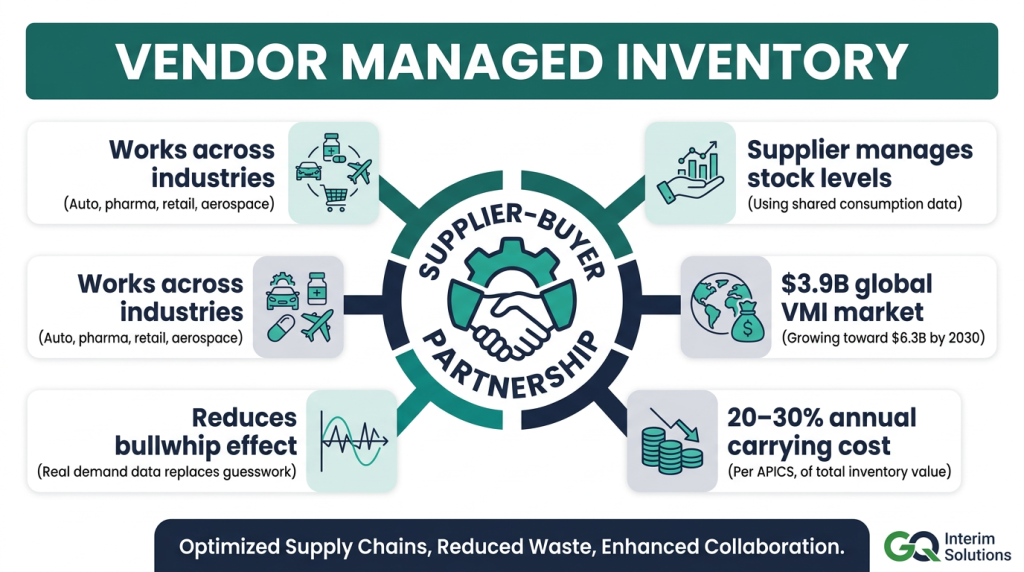
- Wondering if Vendor Management Inventory is right for your plant or network? This guide unpacks how VMI works, where it delivers savings and stability, the pitfalls to avoid, and the KPIs and tech you need to stay in control.

- Managing every supplier the same way rarely delivers the best results. Supplier segmentation helps businesses prioritize supplier relationships, reduce risk, and focus procurement efforts where they create the greatest value.

- Hiring a senior sales leader is one of the most important decisions a growing business can make. Learn how sales executive search works, when it's the right choice, and why it consistently delivers stronger long-term hiring outcomes than traditional recruitment.

- Great products don't happen by accident. Behind every successful product is strong leadership that aligns business strategy, customer needs, and cross-functional teams. Discover what product leadership involves, why it matters, and how it helps businesses make better product decisions.
