Lean tools are practical methods that help a plant remove waste, make flow visible and keep processes stable. The 12 tools manufacturers use most are value stream mapping, 5S, standardized work, kanban, SMED, heijunka, poka-yoke, jidoka, TPM, kaizen, A3 problem solving and hoshin kanri. Each one solves a specific problem, so pick the tool by the problem you see.
Most plants do not lack lean training. They lack a clear answer to a simple question: which tool fits the problem on this line, and in what order should we introduce it? A 5S event will not fix an unstable process, and kanban will not work on a line with long changeovers.
This guide is the overview of all lean tools on our blog. For each tool you get a short definition, the situation where it pays off, the typical mistake, and a link to the detailed article where one exists.
- Choose a lean tool by the problem you see, such as unstable quality, long changeovers or too much stock, not by what is popular.
- Start with the basics: 5S, standardized work and visual management. Kanban, heijunka and SMED only work once the basic discipline is in place.
- Lean tools remove waste and improve flow. Six Sigma tools reduce variation. Many plants combine both.
- A tool without a manager who owns the result fades within months. Measure a baseline first and audit the new standard afterwards.
What are lean tools?
Lean tools, also called lean techniques or lean manufacturing tools, are the methods behind lean production. Most of them come from the Toyota Production System, developed by Taiichi Ohno and Shigeo Shingo from the 1950s onwards. Today they are used in automotive, electronics, machinery, food and almost every other kind of manufacturing.
Every lean tool serves one of four purposes: it makes waste visible, it creates flow, it builds quality into the process, or it keeps the improvement going. Knowing the purpose helps you see which tools belong together.
Lean tools are simple, visual methods that let the people who do the work see waste, remove it and make the better way the new standard.
What waste do lean tools remove?
Lean names eight types of waste, often remembered by the acronym DOWNTIME: defects, overproduction, waiting, unused talent, transport, inventory, motion and extra processing. In Japanese the general word for waste is muda.
Lean also names two causes of waste. Mura is unevenness, for example demand that goes up and down sharply. Muri is overburden on people or machines. Some tools, such as heijunka, target mura directly. Others, such as 5S or SMED, remove muda at one workstation.
Which lean tool fits which problem?
Use this table as a starting point. Find the problem that costs you most, start with the tool in the second column and add the third once the first one works.
| Problem you see | Start with | Then add | Metric to watch |
|---|---|---|---|
| Nobody sees the whole flow from order to delivery | Value stream mapping | Kaizen events on the biggest gaps | Lead time, share of value-added work |
| Searching for tools, parts and documents | 5S | Visual management, standardized work | Search effort per shift, 5S audit score |
| Every shift does the job differently | Standardized work | Gemba walks, layered audits | Cycle variation, first pass yield |
| Too much stock between operations | Kanban, pull system | Heijunka | Work in progress, days of stock |
| Long changeovers force big batches | SMED | Smaller batches, heijunka | Changeover duration |
| Demand swings overload the line | Heijunka | Kanban, standardized work | Output stability per day |
| Repeated assembly or handling errors | Poka-yoke | Jidoka, standardized work | Defects per million, scrap rate |
| Defects pass to the next station | Jidoka and andon | Root cause analysis | Escaped defects, line stops |
| Frequent breakdowns and minor stops | TPM | SMED, 5S | OEE, mean time between failures |
| The same problem keeps coming back | A3 problem solving | Poka-yoke, standardized work | Repeat complaints |
| Improvement projects pull in different directions | Hoshin kanri | Kaizen events | Progress on 2–3 plant objectives |
| One bottleneck limits the whole plant | Theory of constraints | SMED, TPM at the bottleneck | Output of the bottleneck |
If the cause of a defect is hidden in process data rather than visible on the shop floor, lean tools are not enough. Then use statistical tools, described in the Six Sigma section below.
What are the 12 most used lean tools?
The list follows the usual path through a plant: first see the flow, then stabilize it, then make it flow, then build in quality, and finally keep improving.
1. Value stream mapping
Value stream mapping, or VSM, draws the material and information flow of one product family from the supplier to the customer. The current state map shows where waiting, stock and rework sit. The future state map shows the target flow.
When to use it: at the start of a lean program, before a layout change, or when lead time is much longer than the actual processing work.
Typical mistake: drawing the map in a meeting room from the ERP data instead of walking the process. Another mistake is a nice future state map without an action plan and owners. See value stream mapping examples with current and future state maps.
2. 5S
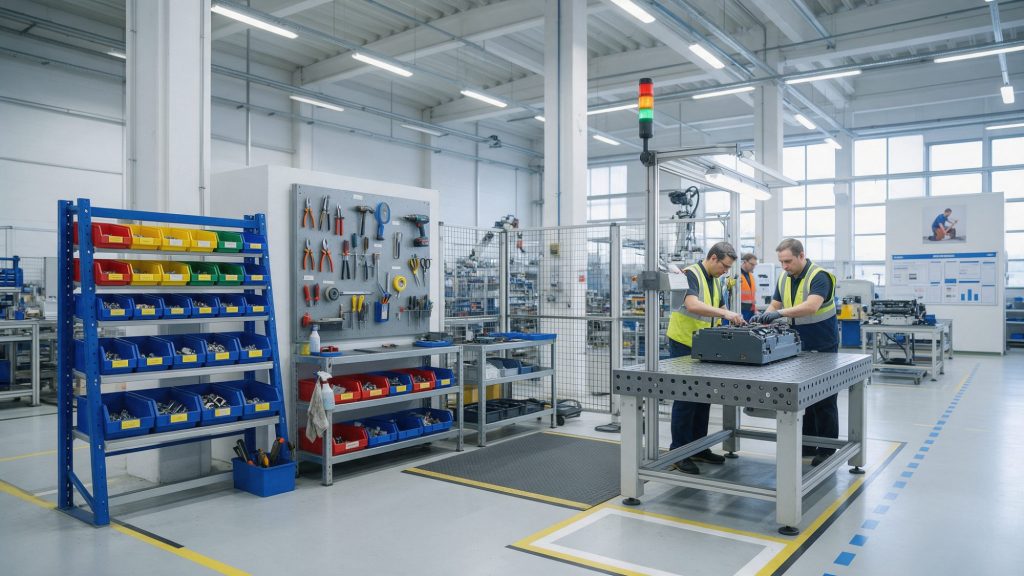
5S stands for sort, set in order, shine, standardize and sustain. It creates a clean, organized workplace where every tool and part has a marked place and problems become visible.
When to use it: as the first visible lean step in an area, before standardized work, and wherever people spend effort searching for things.
Typical mistake: treating 5S as a one-off cleaning action. Without the fourth and fifth S, regular audits and a manager who checks them, the area slides back within weeks. See 5S examples for each step.
3. Standardized work
Standardized work is the agreed best way to do a task. It defines the work sequence, the cycle the operator must meet and the standard amount of material at the station. It is the baseline for every further improvement.
When to use it: when results depend on who is on shift, when you train new operators, and after every kaizen event to lock in the gain.
Typical mistake: writing long work instructions that nobody reads. Good standard work fits on one page, uses photos and is checked on the line by the team leader.
4. Kanban and pull system
Kanban is a signal, usually a card or an empty bin, that tells the previous process what to produce or deliver and how much. Production is pulled by real consumption instead of pushed by a forecast.
When to use it: when stock piles up between operations, for repeated parts with steady demand, and for supplying the line from a supermarket.
Typical mistake: introducing kanban before the process is stable. If changeovers are long or machines often stop, the cards do not move correctly and people go back to the old way.
5. SMED, quick changeover
SMED stands for single-minute exchange of die. Shigeo Shingo developed it to shorten changeovers. The team separates internal steps, done while the machine stands, from external steps, done while it runs, and moves as much as possible into the external group.
When to use it: on presses, molding machines and machining centers where changeovers force large batches, and at the bottleneck.
Typical mistake: a video analysis and a workshop without new standard work and preparation carts. The first changeover is fast, the tenth is back to the old duration.
6. Heijunka, production leveling
Heijunka levels the volume and the mix of production, so the line makes a steady, repeating pattern of products instead of large batches of one type.
When to use it: when demand swings overload people and machines, when stock of some types is high while others are missing, and before introducing pull with kanban.
Typical mistake: trying to level without short changeovers. Leveling the mix needs SMED first. See heijunka explained with the heijunka box.
7. Poka-yoke, mistake-proofing
Poka-yoke is a simple device or design that prevents an error or detects it at once. Examples are a fixture that accepts the part only in one orientation or a sensor that counts the screws.
When to use it: for repeated human errors in assembly, packing or handling, and for characteristics marked as critical in the PFMEA.
Typical mistake: relying on warnings that operators learn to ignore. Where the risk is high, use a control that stops the process. See poka-yoke examples from manufacturing.
8. Jidoka and andon
Jidoka means building quality into the process: a machine or an operator stops as soon as an abnormality appears, so no defect reaches the next station. Andon is the signal, a light or a cord, that calls for help.
When to use it: when defects are found far downstream or at the customer, and on automated lines that can run for a long period without an operator.
Typical mistake: installing andon lights without a response routine. If nobody comes when the light turns on, operators stop using it. See jidoka in lean manufacturing.
9. TPM and OEE
Total productive maintenance, or TPM, makes operators responsible for basic care of their machines, such as cleaning, inspection and lubrication, while maintenance focuses on planned work. OEE, overall equipment effectiveness, measures the result as availability × performance × quality.
When to use it: when breakdowns, minor stops and speed losses limit output, especially at the bottleneck machine.
Typical mistake: chasing a high OEE benchmark instead of the biggest loss. Break OEE down into its six losses and attack the largest one.
10. Kaizen and kaizen events
Kaizen means continuous improvement through many small steps by the people who do the work. A kaizen event is a focused 3–5 day workshop in which a cross-functional team improves one process.
When to use it: to remove waste found in the value stream map, to introduce 5S or SMED in one area, and to restart improvement work that has stalled.
Typical mistake: events without a baseline, standard work and follow-up audits. Results fade and people lose trust in lean. See the benefits of kaizen and how to keep them.
The interim management guide for manufacturing companies
When an experienced interim manager is the fastest way to restart lean work and get results that last.
- When an interim manager pays off
- How to write a mandate
- The first 30 days, week by week
11. A3 problem solving, PDCA and gemba walks
A3 problem solving fits the whole PDCA cycle, plan, do, check, act, on one sheet of A3 paper: the problem, the current state, the root cause, the countermeasures and the check. The work starts at the gemba, the place where the problem happens. Regular gemba walks by managers keep problems visible.
When to use it: for recurring quality or delivery problems, for customer complaints and as a coaching tool for team leaders.
Typical mistake: filling in the A3 at a desk and jumping to a solution before the root cause is proven. See root cause analysis examples with 5 Why and fishbone, and structured problem solving.
12. Hoshin kanri, policy deployment
Hoshin kanri connects the plant’s two or three breakthrough objectives with the projects and metrics of each department, often on an X matrix, and agrees them through catchball between levels.
When to use it: when many improvement projects run at once but the plant results do not move, and in annual planning.
Typical mistake: too many objectives. A hoshin with ten priorities has none. See hoshin planning in 6 steps.
In which order should you introduce lean tools?
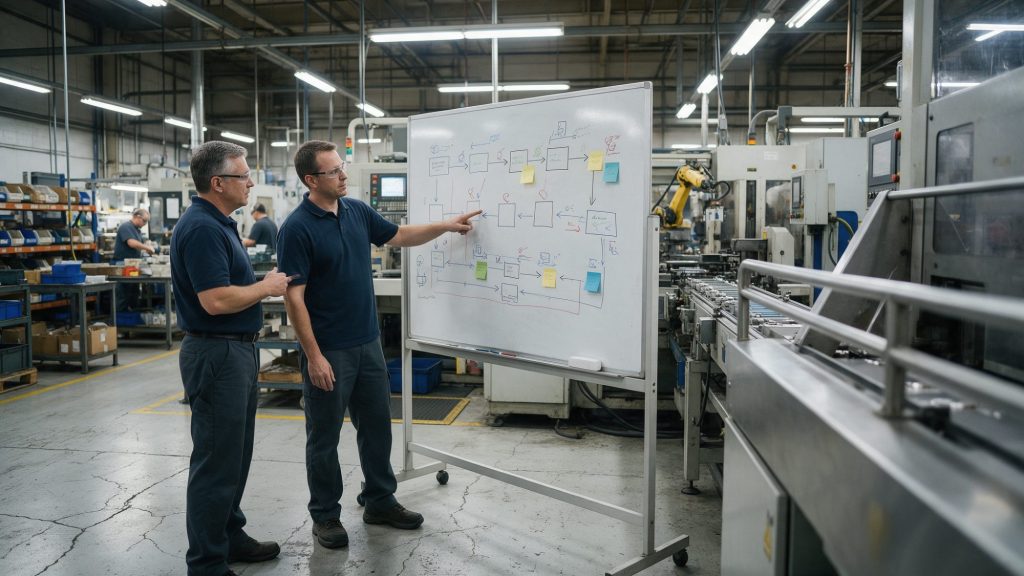
There is no single correct sequence, but most successful plants follow the same logic. They build stability first and flow second, because advanced tools amplify whatever discipline already exists.
- See the flowMap one product family with value stream mapping and choose the two or three biggest gaps.
- Create basic orderIntroduce 5S and visual management in the target area, so problems become visible.
- Stabilize the processWrite standardized work, start gemba walks and set up TPM basics on the key machines.
- Build in qualityAdd poka-yoke on repeated errors and jidoka with a clear andon response.
- Create flow and pullShorten changeovers with SMED, then level production with heijunka and connect processes with kanban.
- Keep improvingRun kaizen events and A3 problem solving, and steer them with hoshin kanri toward the plant objectives.
Many plants have kanban cards, 5S boards and A3 forms, yet results do not change. Lean is a management system: leaders go to the shop floor, problems are made visible and solved by the team, and standards are checked. Without that routine, any tool becomes paperwork.
What is the difference between lean tools and Six Sigma tools?
Lean tools remove waste and speed up flow. Six Sigma tools reduce variation with data and statistics, usually inside the DMAIC cycle: define, measure, analyze, improve, control. Lean Six Sigma combines both sets in one program.
| Goal | Typical lean tools | Typical Six Sigma tools |
|---|---|---|
| Understand the process | Value stream mapping, gemba walk | SIPOC, process map |
| Find the cause of a problem | 5 Why, A3 | Fishbone, hypothesis testing, regression |
| Prevent errors | Poka-yoke, jidoka | FMEA, design of experiments |
| Control the process | Standardized work, visual management | Statistical process control, control plan |
| Measure capability | OEE, lead time | Cp and Cpk, measurement system analysis |
Use lean tools when the waste is visible on the shop floor. Use Six Sigma tools when the cause is hidden in the data. Read more in lean vs Six Sigma and statistical process control.
A third method often sits next to both. The theory of constraints tells you where to apply lean tools first: at the bottleneck that limits the output of the whole plant.
How do you make lean tools deliver results?
The tools are easy to learn. Making them stick is the hard part. Plants that get lasting results do a few things consistently:
- Measure a baseline before any change and confirm the result with controlling.
- Start in one pilot area and copy the approach only after it works there.
- Write the new standard after every improvement and train every shift.
- Audit the standard regularly, with layered audits by team leaders and managers.
- Name one owner for each tool and area, with a clear target.
- Review lean metrics in the daily shop floor meeting, not in a separate project report.
Plants that keep their lean gains treat the tools as part of normal management. The team leader checks standard work at the line, the plant manager walks the gemba regularly, and the next improvement starts from the new standard.
How does an interim lean manager help?
Many plants in Central and Eastern Europe know lean tools from training, but the program stops when the lean manager leaves, a launch takes all the attention or nobody has the mandate to change the processes. An experienced interim lean manager can restart the work quickly. They have introduced these tools in other plants and their mandate is to deliver measurable results.
In practice that means a value stream map with a clear target, a sequence of tools that fits your plant, the first kaizen events, standards and audits, and a handover to the permanent team. See our interim lean manager service, and read what an interim manager does.
How GQ Interim helps
Since 2011 we have completed more than 1,550 projects in manufacturing and industrial companies across Central and Eastern Europe, for clients such as Stellantis, Porsche, Siemens, Valeo and Magna. Our database holds 7,500+ verified experts in operations, lean, quality and plant management. We are certified to ISO 9001 and TISAX.
Conclusion
Lean tools work when they match the problem. Map the flow first, build basic order and stable standards, then add flow, pull and built-in quality. Use Six Sigma tools when the cause is hidden in the data.
The tools themselves are simple. Results come from managers who go to the shop floor, check the standards and keep the improvement going.
Get your lean program moving this month
Tell us which plant or line needs results. We come back with lean experts who have introduced these tools before.
Frequently asked questions
What are the main lean tools?
The most used lean tools in manufacturing are value stream mapping, 5S, standardized work, kanban, SMED, heijunka, poka-yoke, jidoka, TPM, kaizen, A3 problem solving and hoshin kanri. Visual management and gemba walks support all of them.
Which lean tool should a plant start with?
Most plants start with value stream mapping to see the flow, and with 5S and standardized work to create basic order. Kanban, heijunka and SMED come later, once the process is stable.
What are the 5 lean principles?
The five lean principles from Womack and Jones are: define value from the customer’s view, map the value stream, create flow, establish pull and pursue perfection. Lean tools are the practical methods to apply these principles.
What is the difference between lean tools and Six Sigma tools?
Lean tools such as 5S, kanban and SMED remove waste and improve flow. Six Sigma tools such as statistical process control, design of experiments and capability analysis reduce variation using data. Lean Six Sigma uses both.
What is the difference between 5S and kaizen?
5S is one specific tool for workplace organization. Kaizen is the principle of continuous improvement, and a kaizen event is a workshop format. Many plants run their first kaizen event to introduce 5S.
Are lean tools only for manufacturing?
No. Lean tools are also used in logistics, offices, hospitals and software teams. This guide focuses on manufacturing, where most of the tools were developed.
How do you measure the benefits of lean tools?
Record a baseline before the change, for example work in progress, OEE, scrap rate or changeover duration, and measure the same metric after it. Ask controlling to confirm the savings and track the metric for at least 90 days.
Do digital tools replace classic lean tools?
No. Digital andon, live OEE dashboards and electronic kanban make the data faster and easier to share, but they only work on top of a stable process and clear standards. Start with the classic tools on the shop floor.
Who should lead lean in a manufacturing plant?
A manager with lean experience and the authority to change processes, usually from operations or quality. If no one in the plant has the capacity, an interim lean manager can lead the first projects and build the routine for the permanent team.